Every few years, a new language learning method arrives with bold promises. Immersive video courses. Gamified apps with cartoon mascots. AI chatbots that simulate conversation. Virtual reality classrooms. And yet, after all the innovation, the single most effective tool for memorizing vocabulary remains something a 19th-century student would recognize instantly: the flashcard.
That is not nostalgia. It is neuroscience. Flashcards work because they tap into two of the most powerful mechanisms in human memory: active recall and the testing effect. These are not trendy concepts. They are fundamental properties of how the brain stores and retrieves information. And in 2026, AI has taken these timeless principles and made them dramatically more effective.
Let us look at how we got here, why the basic mechanic endures, and what modern flashcard apps do differently from the paper cards your grandparents used.
A Brief History of Flashcards
The flashcard as we know it traces back to the early 1800s, when educator Favell Lee Mortimer created sets of printed cards to teach children reading and arithmetic. By the mid-1900s, handwritten index cards were a staple of student life. You would write a word on one side, the definition on the other, and flip through the deck until the answers stuck.
The method was simple, cheap, and surprisingly effective. But it had a fundamental problem: it treated every card the same. Whether you knew a word perfectly or had never seen it before, it came up at the same frequency. You wasted time on words you already knew and did not spend enough time on the ones you did not.
In the 1970s, German journalist Sebastian Leitner introduced the Leitner system, which sorted cards into boxes based on how well you knew them. Cards you got right moved to a box you reviewed less often. Cards you got wrong moved back to the frequent-review box. It was a rudimentary form of spaced repetition, and it worked remarkably well.
The digital revolution brought software like SuperMemo in 1987 and Anki in 2006, which replaced the physical boxes with algorithms. These programs could track thousands of cards, calculate optimal review intervals to the day, and adapt to each user's individual learning curve. The core mechanic was the same as Mortimer's cards from 1830. The scheduling was centuries more sophisticated.
Why the Core Mechanic Endures: Active Recall and the Testing Effect
The reason flashcards have survived for 200 years while countless other study methods have come and gone is that they force your brain to do the one thing that actually builds memory: retrieve information from scratch.
When you look at the front of a flashcard and try to produce the answer before flipping it over, you are engaging in active recall. This is fundamentally different from passive review, where you read “casa = house” and think, “Yes, I knew that.” Passive review feels productive but barely strengthens memory. Active recall feels harder, and that difficulty is precisely what makes it work.
Cognitive psychologists call this the testing effect (also known as retrieval practice). A landmark 2011 study by Karpicke and Blunt, published in Science, demonstrated that students who practiced retrieval retained 50% more material than those who studied using other methods, including elaborative concept mapping. The act of pulling information out of memory strengthens the neural pathways far more than putting information in.
A 2013 meta-analysis by Rowland, also published in a major psychology journal, reviewed 159 studies on the testing effect and confirmed that retrieval practice produces large, consistent benefits across ages, material types, and testing conditions. It is one of the most robust findings in all of learning science.
This is why flashcards keep outperforming supposedly more advanced methods. It is not the card itself that matters. It is the act of seeing a prompt and generating an answer from memory. That single mechanic, repeated across thousands of vocabulary words, is what builds fluency.
Flashcards, supercharged by AI
VocaSwipe combines the proven power of active recall with AI-driven spaced repetition. Learn Spanish vocabulary the way your brain actually works.
Paper vs. Digital Flashcards: An Honest Comparison
Before diving into what AI brings to the table, it is worth acknowledging that paper flashcards still have genuine strengths. Here is an honest comparison:
Where Paper Wins
- Tactile memory: The physical act of writing a word by hand creates an additional memory trace. Research on the production effect shows that producing information (writing, speaking) strengthens encoding more than passive consumption.
- Zero distractions: A stack of index cards cannot send you notifications, lure you into social media, or drain your phone battery. The simplicity is genuinely valuable.
- No learning curve: Everyone already knows how to use a flashcard. There is no app to learn, no settings to configure, no account to create.
Where Digital Wins
- Spaced repetition scheduling: This is the single biggest advantage. A digital app can track your performance on every individual card and calculate the mathematically optimal time for you to review it. Doing this manually with paper cards is theoretically possible but practically unrealistic beyond a few dozen cards.
- Audio and pronunciation: Paper cannot play audio. Digital cards can include native speaker pronunciation, which is critical for languages like Spanish where hearing the correct sounds matters. Check out our Spanish pronunciation guide for more on why this matters.
- Scale: Managing 5,000 paper flashcards is a logistical nightmare. A digital system handles it seamlessly, with perfect tracking and zero physical storage.
- Data and insights: Digital apps show you your retention rate, weak areas, learning velocity, and progress toward goals. This feedback loop is impossible with paper.
- Portability: Your entire vocabulary library fits in your pocket. No need to carry around rubber-banded stacks of index cards.
For casual learners studying a small number of words, paper flashcards are perfectly fine. For anyone seriously building vocabulary toward fluency, the scheduling and tracking advantages of digital make it the clear choice. And then AI takes things even further.
How AI Transforms Flashcards
Traditional digital flashcard apps like Anki use fixed algorithms for spaced repetition. They work well, but they apply the same scheduling formula to every user. AI-powered flashcard systems go several steps further:
Adaptive Difficulty
An AI system does not just track whether you got a card right or wrong. It analyzes patterns in your responses: how quickly you answered, whether you hesitated, which types of words you consistently struggle with, and how your performance varies by time of day or session length. It uses this data to adjust not just when you see a card, but how it is presented.
If you consistently confuse two similar words, the system might start showing them in closer succession so you learn to differentiate. If you nail concrete nouns but struggle with abstract verbs, it will weight your sessions accordingly.
Smart Scheduling (Advanced SRS)
Classical spaced repetition uses a mathematical formula with a few parameters. AI-enhanced scheduling uses machine learning models trained on millions of data points from real learners. The result is more precise timing: showing you each word closer to the actual moment you would forget it, rather than using an approximation.
Research on these next-generation scheduling algorithms shows a measurable improvement in retention rates over classical SRS, particularly for learners with irregular study patterns. If you miss a few days, the AI adjusts your review queue intelligently rather than dumping hundreds of overdue cards on you at once.
Personalized Content
AI can recommend which words to learn next based on your goals, current level, and learning history. If you are preparing for travel, it prioritizes travel vocabulary. If you are building toward a specific CEFR level, it focuses on the frequency-ranked words that will get you there fastest.
Audio and Pronunciation
Modern AI speech synthesis produces natural-sounding pronunciation for every word in the deck. This means you are not just learning to read Spanish words — you are learning to hear and recognize them. For a language where pronunciation is relatively regular (like Spanish), this audio component accelerates the transition from reading vocabulary to using it in real conversations.
Follow @vocaswipe on TikTok
Quick vocabulary tips, flashcard strategies, and daily Spanish challenges.
What Makes Modern Flashcard Apps Different from Anki
Anki deserves enormous credit. Released in 2006, it brought spaced repetition to millions of language learners and remains a powerful tool. But it was designed in an era before smartphones were ubiquitous and before AI was practical for consumer apps. Modern flashcard applications have evolved in several important ways:
- No setup required: Anki's power comes with complexity. Creating decks, configuring intervals, finding or building card templates — it is a steep learning curve. Modern apps like VocaSwipe come pre-loaded with curated, frequency-ranked vocabulary organized by topic and CEFR level. You download the app and start learning in under a minute.
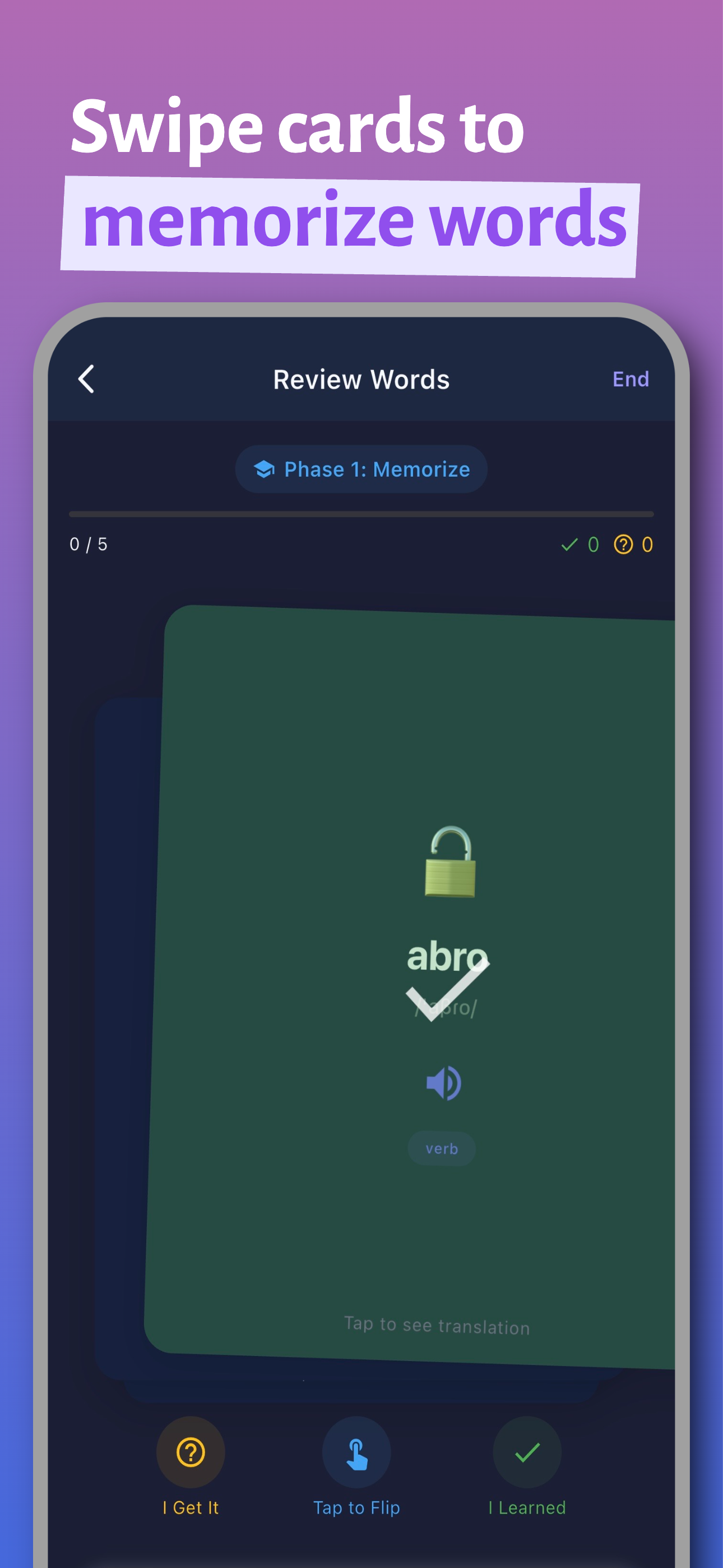
- Mobile-first design: Anki was built for desktop first. Modern apps are designed for the phone in your pocket, with interfaces optimized for quick thumb gestures. A swipe-based interface, for instance, lets you move through cards faster than clicking buttons on a desktop screen.
- Built-in audio: Every card includes native pronunciation. No need to hunt for audio files or install third-party plugins.
- Progress visualization: Modern apps show your trajectory: how many words you know, your streak, your projected time to reach the next CEFR level. This gamification is lightweight but effective for maintaining motivation over months of study.
- AI scheduling: Rather than a fixed algorithm, the review timing adapts to your actual behavior patterns. The system learns you as you learn Spanish.
None of this means Anki is bad. It means the landscape has evolved. If you are comfortable with Anki's interface and enjoy building your own decks, it remains excellent. If you want something that works out of the box with minimal configuration and modern AI scheduling, newer apps have the edge.
Putting It All Together: AI-Enhanced Flashcards in Practice
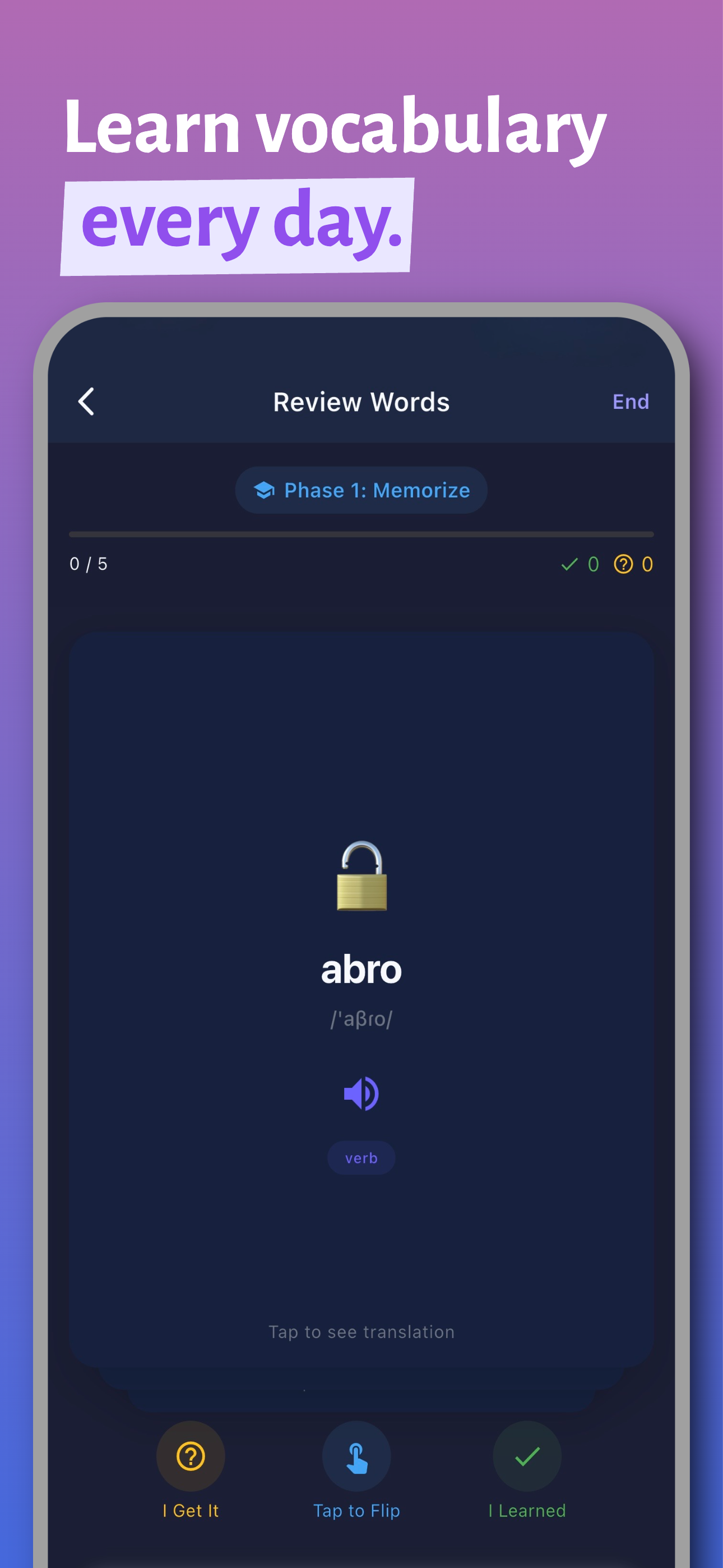
VocaSwipe is a practical example of how these advances come together. The app combines a curated Spanish vocabulary deck with AI-powered spaced repetition, audio pronunciation, and a swipe-based interface designed for 5-minute sessions. You see a Spanish word, try to recall the meaning, swipe to indicate whether you knew it, and the algorithm schedules the next review at the optimal moment.
The result is a system where the 200-year-old active recall mechanic is amplified by scheduling technology that would have been impossible even a decade ago. The flashcard did not need reinventing. It needed smarter infrastructure, and that is exactly what AI provides.
Experience AI-powered flashcards
VocaSwipe takes the proven science of flashcards and adds AI-driven spaced repetition, audio pronunciation, and smart progress tracking. Try it free.
Key Takeaways
- Flashcards work because of active recall. Retrieving information from memory strengthens neural pathways far more than passive review.
- The testing effect is one of the most robust findings in learning science. Students who practice retrieval retain 50% more material than those using other study methods.
- Digital beats paper for serious learners. Automated spaced repetition scheduling, audio, and progress tracking give digital flashcards a clear advantage at scale.
- AI makes flashcards adaptive. Modern apps learn your patterns and adjust difficulty, timing, and content to match your individual learning curve.
- The core mechanic has not changed in 200 years. See a prompt, produce an answer, check yourself. Everything else is optimization on top of that foundation.
- Modern apps remove the setup friction. Pre-built decks, mobile-first design, and built-in audio mean you can start learning in under a minute.
Frequently Asked Questions
Are digital flashcards better than paper?
For vocabulary learning at scale, digital flashcards have significant advantages. They implement spaced repetition algorithms automatically, track your performance on every individual card, include audio pronunciation, and adapt to your learning patterns in real time. Paper flashcards still work for the core mechanic of active recall, but you lose the scheduling intelligence that makes spaced repetition so powerful. For small decks of under 50 cards, paper is fine. For building a vocabulary of thousands of words, digital is the clear winner.
How does AI improve flashcards?
AI enhances flashcards in several ways: adaptive difficulty adjustment that learns which words you struggle with, smart scheduling using machine learning models trained on millions of data points, personalized content recommendations based on your goals and patterns, and natural audio pronunciation for every word. The result is a flashcard experience that continuously adapts to your individual memory patterns rather than using a one-size-fits-all formula.
How many flashcards should I study per day?
A good daily target is 5-15 new flashcards plus all cards scheduled for review by your spaced repetition system. The review pile will vary depending on your history. Beginners should start with 5-8 new cards per day and increase gradually. The most important thing is sustainability: it is better to consistently study 8 new cards daily for months than to burn through 30 per day for a week and then quit. Most learners find that a total session of 5-10 minutes handles both new cards and reviews comfortably.