What if you could remember every Spanish word you learn? Not just for a test, not just for a week, but permanently. That sounds too good to be true, but it is essentially what spaced repetition delivers.
Spaced repetition is the closest thing to a cheat code for language learning. It is a study technique built on over 140 years of memory research, and it is the reason why some people seem to effortlessly accumulate huge vocabularies while others struggle to retain even basic words.
The difference is not talent or intelligence. It is timing. Spaced repetition is fundamentally about when you review, not how much you review. And when you get the timing right, the results are extraordinary.
Whether you are just starting to build your Spanish vocabulary or looking for a more efficient study method, understanding the science behind spaced repetition will change how you approach learning.
Experience spaced repetition in action
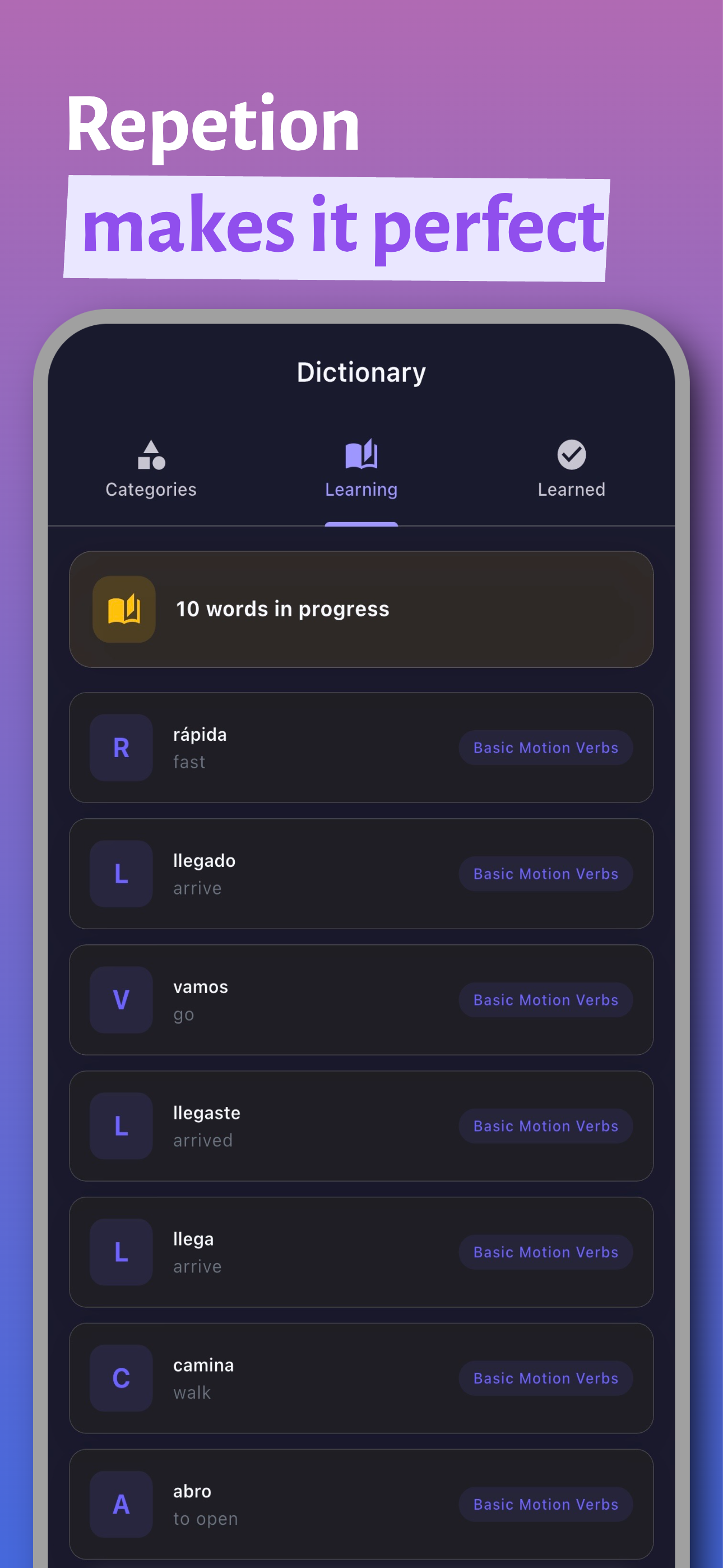
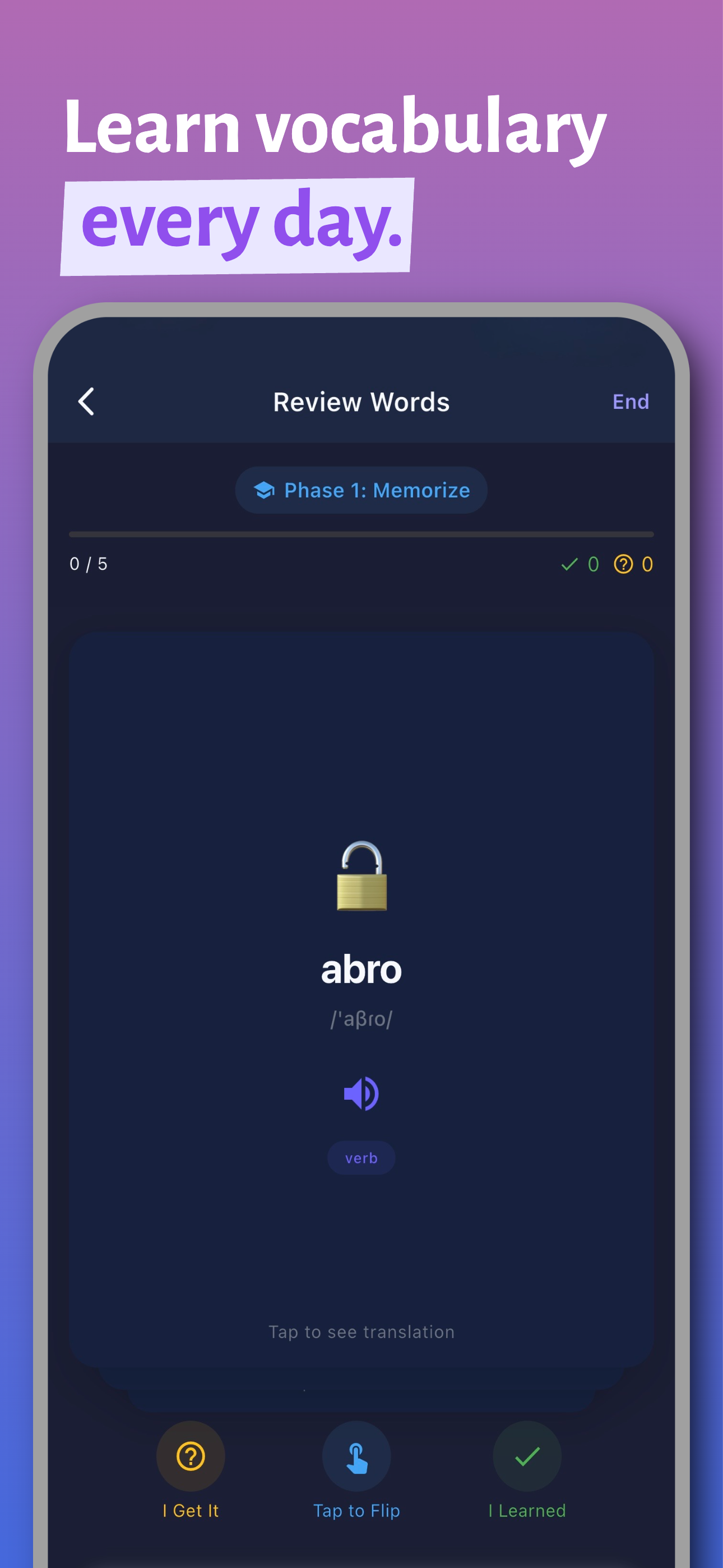
VocaSwipe's AI-powered SRS algorithm schedules every review at the perfect moment. Learn Spanish vocabulary that actually sticks.
What Is Spaced Repetition?
Spaced repetition is a learning technique where you review information at gradually increasing intervals. Instead of studying the same material over and over in a single sitting, you spread your reviews out over days, weeks, and eventually months.
The core idea is simple: review each piece of information just before you are about to forget it. This point, sometimes called the optimal recall moment, is where a review has the maximum impact on long-term memory.
The concept has a surprisingly long history. Hermann Ebbinghaus, a German psychologist, first documented the principles behind it in 1885 in his groundbreaking work Über das Gedächtnis (On Memory). Through rigorous self-experimentation with nonsense syllables, he mapped out exactly how memory decays over time, and how strategic review can counteract that decay.
For decades, his findings remained largely academic. Then in the 1970s, Sebastian Leitner developed the Leitner box system, a physical flashcard method based on spaced intervals. And with the rise of computers and smartphones, spaced repetition evolved into sophisticated algorithms that track your performance on every individual item and calculate the perfect review schedule automatically.
Today, spaced repetition systems (SRS) power the most effective vocabulary learning tools available. They are the engine behind apps like VocaSwipe, and they are the reason why modern flashcard-based learning is so dramatically more effective than traditional study methods.
The Forgetting Curve Explained
Before you can understand why spaced repetition works, you need to understand the problem it solves: the forgetting curve.
When you learn a new Spanish word, say “mariposa” (butterfly), your brain creates a new memory trace. That trace is initially strong. You just saw the word, you know what it means, and if someone asked you right now, you could recall it instantly.
But as time passes without reinforcement, that memory trace weakens. Ebbinghaus measured this decay precisely:
- After 20 minutes: You have already forgotten about 40% of the new information.
- After 1 hour: Roughly 55% is gone.
- After 24 hours: About 70% has faded.
- After 1 week: Over 90% is lost.
- After 1 month: You retain less than 5% of the original information.
These numbers are for unreinforced memories of unfamiliar material. The exact percentages vary based on factors like how meaningful the material is, how much sleep you get, and your existing knowledge base. But the curve shape is consistent across all types of learning: a steep initial drop followed by a more gradual decline.
The key insight: The forgetting curve is not a death sentence for your memories. It is a map showing exactly when your memories need reinforcement. And each time you reinforce a memory at the right moment, the curve flattens. The memory becomes more durable, and the interval before the next required review gets longer.
This is the fundamental principle that makes spaced repetition work. You are not fighting the forgetting curve. You are using it.
How SRS Algorithms Work
A modern spaced repetition algorithm tracks three things for every word in your vocabulary:
- How many times you have reviewed it (review count)
- How well you recalled it each time (quality of recall)
- When you last reviewed it (time since last review)
Based on these three data points, the algorithm calculates the optimal interval before your next review. Here is what a typical schedule looks like for a word you are learning successfully:
- First review: 1 day after learning
- Second review: 3 days after the first review
- Third review: 7 days later
- Fourth review: 21 days later
- Fifth review: 60 days later
- Sixth review: 120+ days later
Notice how the intervals expand exponentially. After just 5-6 successful reviews spread over a few months, a word that you initially had to review every day now only needs a check-in every four months or longer. The word has effectively moved from short-term to long-term memory.
But here is where it gets clever: the algorithm adapts to your memory. If you get a word wrong, it resets the interval to a shorter period. If you hesitate before answering, it might slow the expansion. If you recall instantly, it might accelerate it. The system is learning how you learn, and personalizing the schedule accordingly.
The result is that you spend the minimum possible time reviewing words you know well, and the maximum useful time on words you find difficult. No time is wasted reviewing words you could recall in your sleep, and no words slip through the cracks because you did not review them soon enough.
The Science: 200% Better Retention
The claim that spaced repetition improves retention by 200% is not marketing. It comes from a comprehensive 2016 meta-analysis published in Psychological Bulletin by researchers Cepeda, Vul, Rohrer, Wixted, and Pashler. Analyzing data from hundreds of studies involving tens of thousands of participants, they found that spacing out practice consistently produced retention rates roughly three times higher than massed practice.
Other significant studies reinforce this:
- Bahrick et al. (1993): Studied long-term retention of Spanish vocabulary specifically. Students who used spaced study sessions retained significantly more vocabulary after 5 years compared to those who crammed the same amount of material.
- Karpicke & Bauernschmidt (2011): Demonstrated that combining spaced repetition with active recall (testing) produced the highest retention rates of any study method tested.
- Kornell (2009): Found that even when students felt like massed practice was more effective (because the material seemed easier during cramming), spaced practice actually produced significantly better results on delayed tests.
That last finding is particularly important. Our intuitions about learning are often wrong. Cramming feels productive because you can recognize the material easily during the session. But recognition is not the same as recall. The real test is whether you can produce the word from memory days or weeks later, and that is where spaced repetition dominates.
Spaced Repetition vs. Traditional Study Methods
To understand why spaced repetition is so much more effective, it helps to compare it directly with the alternatives:
| Method | Retention After 1 Week | Retention After 1 Month | Time Efficiency |
|---|---|---|---|
| Cramming | ~30% | ~5-10% | Low |
| Re-reading word lists | ~25% | ~10% | Very Low |
| Writing words repeatedly | ~35% | ~15% | Low |
| Basic flashcards (no SRS) | ~40% | ~20% | Medium |
| Spaced repetition (SRS) | ~85% | ~80% | High |
The difference in long-term retention is dramatic. After one month, spaced repetition retains roughly 80% of learned material, while cramming retains less than 10%. But the time efficiency gap is equally important: because SRS focuses your review time on the words that actually need it, you spend far less total time to achieve far better results.
Consider a practical example. Say you are learning 500 Spanish vocabulary words. With traditional study, you might review all 500 words in each session. With SRS, you might review only 30-50 words per session, because the algorithm knows that 450 of those words do not need review today. You learn the same material in a fraction of the time.
How to Use Spaced Repetition for Spanish
Understanding the theory is one thing. Putting it into practice is another. Here is a concrete, step-by-step approach to using spaced repetition for Spanish vocabulary learning:
Step 1: Start with High-Frequency Words
Not all words are equally useful. Begin with the most commonly used Spanish words, the ones you will encounter and need most often. The top 500 words cover roughly 70% of everyday conversation. Apps like VocaSwipe organize vocabulary by CEFR level, starting with A1 basics and progressing naturally.
Step 2: Set a Daily Review Habit
Spaced repetition only works if you show up consistently. Set a specific time each day for your review session. Morning works best for most people because sleep has just consolidated the previous day's learning, and your brain is fresh for new input.
A 5-minute daily session is enough to maintain a growing vocabulary. As your word count increases, you may want to extend to 10-15 minutes, but never feel pressured to do marathon sessions. The algorithm handles the efficiency for you.
Step 3: Trust the Algorithm
This is where many learners struggle. The SRS algorithm might not show you a word for two weeks, and you might worry you will forget it. Resist the urge to manually review. The algorithm is designed to show you the word just before you would forget it. If it does not appear, the system believes you still remember it, and it is usually right.
Step 4: Use Active Recall, Not Recognition
When a flashcard appears, do not just glance at both sides. See the Spanish word and actively try to produce the English meaning (or vice versa) before revealing the answer. This active recall process is what strengthens the memory trace. Passive recognition (“oh yeah, I knew that”) does not produce the same neurological benefit.
Step 5: Add Context Over Time
As your vocabulary grows, start paying attention to how words appear in context: in sentences, conversations, and media. When you encounter a word you learned through SRS in a real-world context, it creates an additional memory hook that makes the word even more durable. This is why combining flashcard study with practical exposure produces the best results.
Follow @vocaswipe on TikTok
Daily Spanish words, learning tips, and spaced repetition explained visually.
Let the algorithm do the work
VocaSwipe calculates the perfect review schedule for every word you learn. No guessing, no wasted time. Just effective vocabulary building.
Key Takeaways
- The forgetting curve is real. Without reinforcement, you lose 70% of new information within 24 hours and over 90% within a week.
- Spaced repetition counteracts forgetting. By reviewing words at scientifically optimal intervals, each review makes the memory more durable and the next interval longer.
- 200% better retention is backed by research. A comprehensive meta-analysis confirms that spaced practice roughly triples long-term retention compared to massed study.
- SRS algorithms personalize your schedule. The system adapts to your individual memory patterns, focusing your time on words that need it most.
- Consistency matters more than session length. Five minutes of daily SRS review outperforms occasional long study sessions.
- Combine SRS with active recall for maximum effect. Always try to produce the answer before checking. Passive recognition does not build strong memories.
Frequently Asked Questions
How often should I review flashcards?
With a spaced repetition system, you do not decide when to review. The algorithm does. It schedules each card based on your past performance. New words might appear after 1 day, then 3 days, then a week. Easy words get pushed further out (weeks or months between reviews), while difficult words come back sooner. The key is to review every card the system schedules for that day. Most learners spend 5-10 minutes daily on reviews, which typically covers 30-60 cards.
Is spaced repetition better than Duolingo?
Spaced repetition and Duolingo serve different purposes. Duolingo teaches grammar, listening, and reading through gamified lessons. Spaced repetition apps like VocaSwipe focus specifically on vocabulary retention, ensuring you remember every word you learn long-term. Many successful language learners use both: Duolingo for grammar and sentence structure, and a dedicated SRS app for vocabulary building. For pure vocabulary acquisition and retention, spaced repetition is significantly more efficient.
How long until spaced repetition works?
You will notice the effects within the first week. Words that you would normally forget after a day start sticking. After 2-3 weeks of consistent daily practice, you will have a growing base of words that feel permanently memorized. After 2-3 months, you will likely know 300-500+ words with strong retention. The key is daily consistency, even 5 minutes counts. Missing multiple days in a row causes reviews to pile up and reduces the system's effectiveness.