You have probably had this experience: you study a list of new vocabulary words, feel confident you know them, and then a week later you cannot remember a single one. It is not your fault. It is your method.
The way most people try to memorize vocabulary, reading a word and its translation over and over, is one of the least effective strategies that cognitive science has identified. It feels productive because the word seems familiar while you are staring at it. But familiarity is not the same as memory. And the difference between the two is exactly why so many language learners plateau.
The good news is that decades of research in cognitive psychology have produced a clear picture of what actually works for long-term vocabulary retention. None of these techniques are complicated. Most take no additional time. They just require doing things differently than what feels intuitive.
1. Active Recall: Stop Rereading, Start Testing
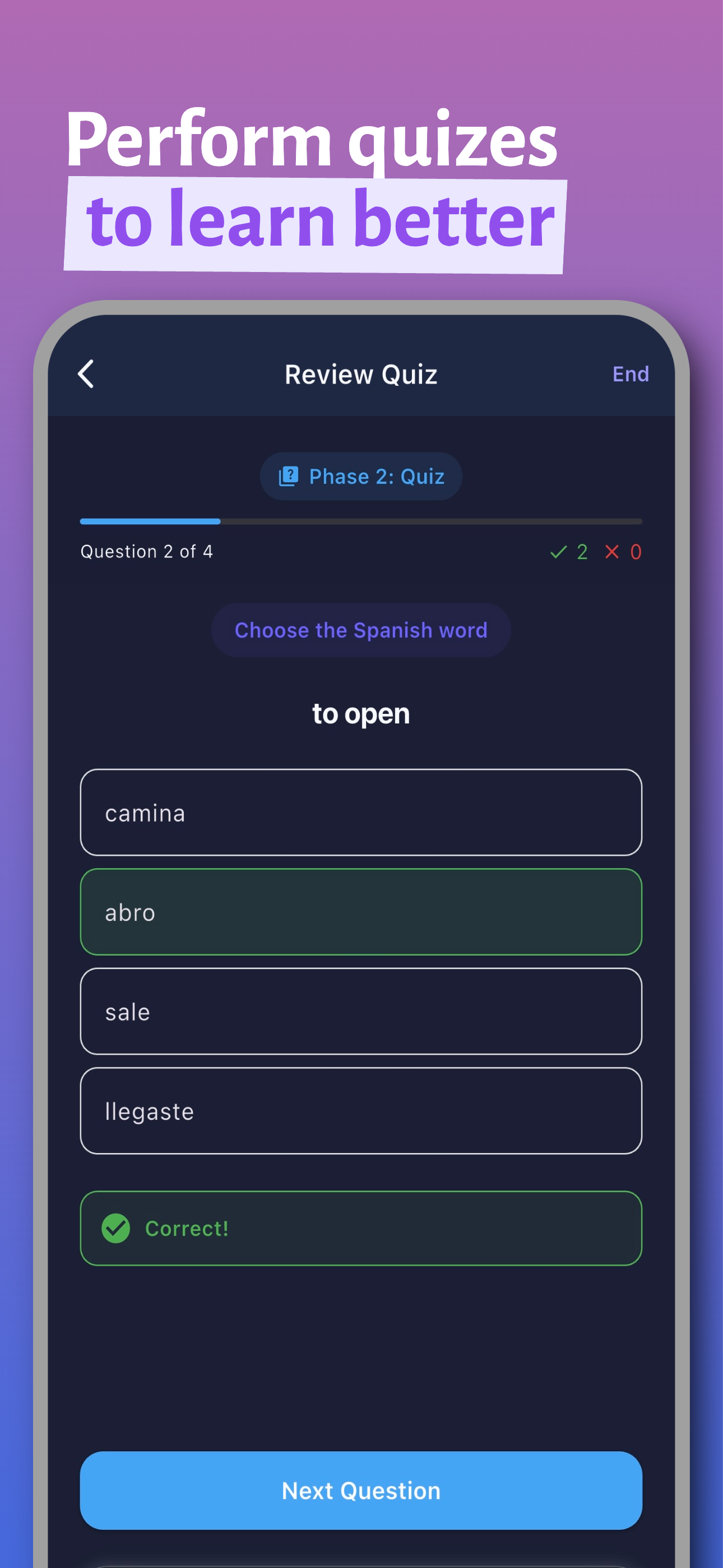
Active recall is the single most powerful learning technique that exists. Period. The concept is simple: instead of looking at a word and its meaning together, you look at the word and try to produce the meaning from memory before checking.
This feels harder than passive review. That difficulty is the whole point. Cognitive psychologists call it desirable difficulty: the mental effort of retrieving a memory actually strengthens the neural pathways associated with it. Every time you successfully pull a word out of your memory, it becomes slightly easier to recall next time.
The research is overwhelming. A landmark 2011 study by Karpicke and Blunt, published in Science, found that students who practiced active recall retained 50% more material than those who used other popular study techniques, including concept mapping, rereading, and highlighting. A 2013 meta-analysis in Psychological Bulletin confirmed the testing effect across hundreds of studies: testing yourself is consistently superior to every form of passive review.
In practice, this means flashcards (done correctly) beat word lists every time. When you see the Spanish word recuerdo, you should pause and actively try to retrieve its meaning (“memory” or “I remember”) before flipping the card. That moment of effort is where the learning happens.
2. Spaced Repetition: The Forgetting Curve Antidote
In 1885, Hermann Ebbinghaus documented what he called the forgetting curve: without reinforcement, you forget roughly 70% of new information within 24 hours and over 90% within a week. Spaced repetition is the systematic antidote to this curve.
The principle is straightforward. Instead of reviewing all your vocabulary at the same frequency, you review each word at the precise moment your memory of it is about to fade. New or difficult words come up frequently (every day or two). Words you know well come up rarely (every few weeks or months). The intervals expand automatically as your memory strengthens.
Research by Bahrick et al. demonstrated that material learned through spaced intervals was retained for years, while the same material learned through massed practice was mostly forgotten within weeks. A 2016 meta-analysis in Psychological Bulletin quantified the effect: spaced practice produces a 200% improvement in long-term retention compared to cramming, across all types of material and all types of learners.
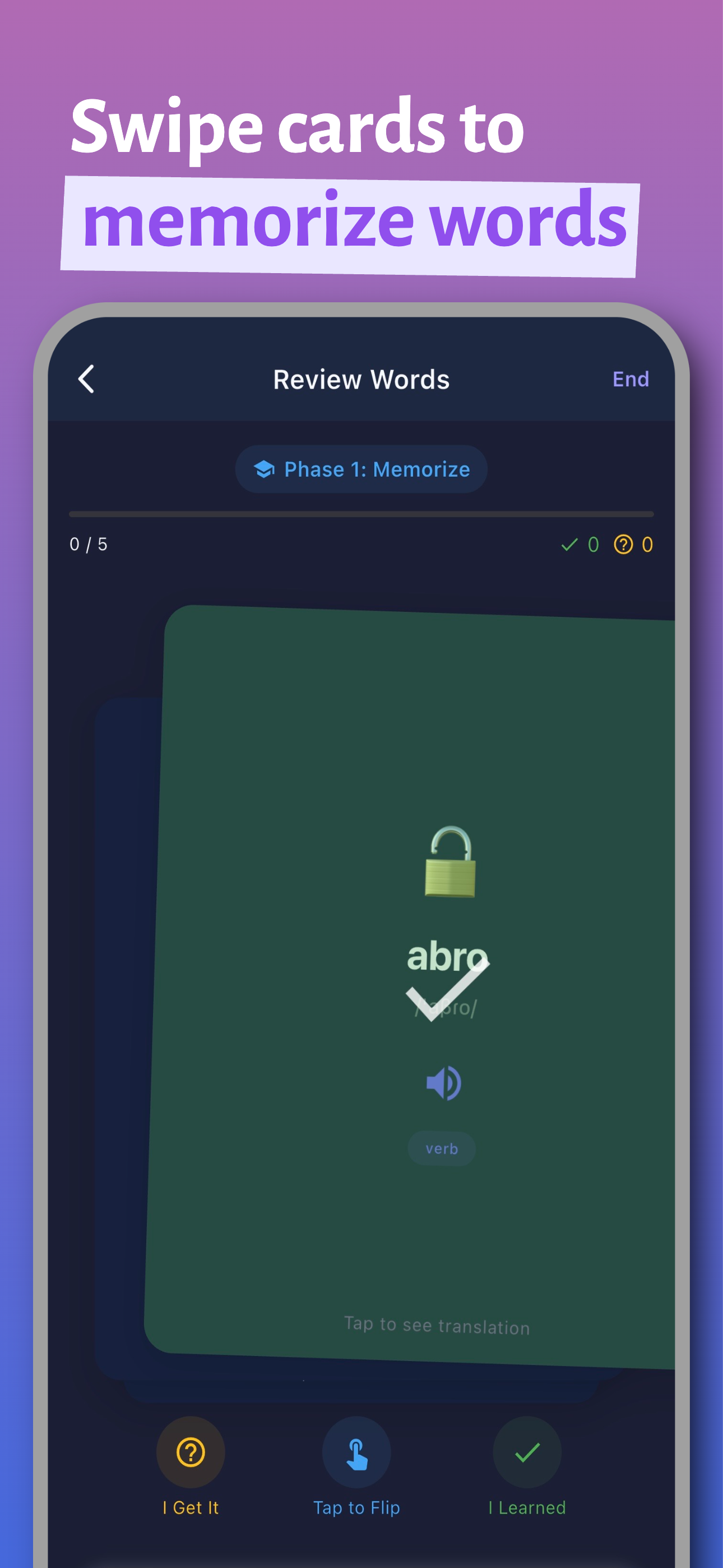
The challenge with spaced repetition used to be the bookkeeping: tracking hundreds of words at different intervals is impossible to do by hand. Modern apps solve this entirely. VocaSwipe, for example, automatically schedules each word's review based on your individual performance, so you never have to think about when to review what. You just open the app and practice whatever it serves you.
Let the algorithm handle your review schedule
VocaSwipe combines active recall and spaced repetition automatically. Just swipe through your daily words and the system optimizes your retention behind the scenes.
3. Memory Palace (Method of Loci): Spatial Memory Hacking
The memory palace technique has been used since ancient Greece, and modern neuroscience has confirmed why it works so well. The method exploits your brain's powerful spatial memory system, which evolved to remember physical environments, and repurposes it for storing abstract information like vocabulary.
Here is how it works: you mentally walk through a familiar place (your home, your commute, your office) and “place” each new word at a specific location. The more vivid and absurd the mental image, the stronger the memory.
For example, to remember that nevera means “fridge” in Spanish, you might imagine walking into your kitchen and finding your fridge completely covered in snow (nieve, the related word for snow, provides a natural hook). To remember that escalera means “staircase,” you picture a giant escalator replacing your stairs.
A 2017 study published in Neuron found that participants who trained with the memory palace technique for just six weeks nearly doubled their memory capacity and maintained those gains four months later. Brain imaging showed lasting changes in the functional connectivity patterns of their brains.
The memory palace is particularly useful for vocabulary that you find hard to remember with other techniques. It requires more initial effort per word, so it is best reserved for stubborn words that keep slipping through spaced repetition.
4. Mnemonics and Associations: Creative Memory Hooks
Mnemonics work by connecting new information to something you already know. For vocabulary, this usually means creating a link between how a foreign word sounds and what it means.
Spanish offers plenty of natural hooks for English speakers. Biblioteca (library) contains “biblio,” like bibliography. Dormitorio (bedroom) contains “dormit,” like dormitory. Enfermo (sick) contains the root of “infirmary.” These cognate connections are free memory anchors.
For words without obvious English connections, you can create your own associations. Perro (dog) sounds a bit like “pair of.” Imagine a pair of dogs. Gato (cat) rhymes with “baton.” Picture a cat twirling a baton. These are absurd on purpose. Research consistently shows that bizarre, vivid, or emotionally charged images are remembered far better than ordinary ones.
A study by Atkinson and Raugh, published in the Journal of Educational Psychology, found that students using the keyword mnemonic method learned foreign vocabulary 70% faster than a control group using rote repetition. The effect held up on tests given days later, confirming that the memories were durable, not just temporary.
5. Context-Based Learning: Words in Sentences
Isolated words are hard to remember because they have nothing to cling to in your memory. A word learned in context, inside a sentence that creates meaning, has multiple memory hooks: the grammar around it, the situation it describes, and the emotional tone of the phrase.
When you learn that cuenta means “bill” in the context of “La cuenta, por favor” (The bill, please), you are not just memorizing a translation. You are encoding a complete scene: a restaurant, the end of a meal, the act of asking the waiter. All of these associations strengthen the memory trace.
Research by Webb (2007) in Applied Linguistics found that words learned in context were retained 40% better than words learned in isolation, and the advantage increased over time. Context-learned words were also more likely to be used correctly in production (speaking and writing), not just recognized in comprehension.
Organizing vocabulary by topic and category amplifies this effect. When you learn all the words related to ordering food together (menú, cuenta, propina, plato, bebida), each word reinforces the others within a shared context.
6. Multi-Sensory Encoding: Read It, Hear It, Write It, Say It
Your brain forms stronger memories when multiple sensory channels are engaged simultaneously. Reading a word activates visual processing. Hearing it activates auditory processing. Writing it activates motor processing. Speaking it activates both motor and auditory processing. Each channel creates a separate memory trace, and the more traces you create, the more likely you are to retrieve the word later.
This is called the dual coding theory, originally proposed by psychologist Allan Paivio. While the theory has been refined over the decades, the core finding remains robust: material encoded through multiple channels is remembered significantly better than material encoded through one channel alone.
Practically, this means your vocabulary study should involve more than just your eyes. Listen to the pronunciation of each new word. Say it out loud yourself. Write it by hand at least once. If an app offers audio playback, always use it. The few extra seconds per word create meaningfully stronger memories.
The Multi-Sensory Stack: For each new word, (1) read the word and translation, (2) listen to the native pronunciation, (3) say it out loud twice, (4) use it in a short sentence. This takes about 20 seconds per word and dramatically improves retention compared to just reading.
Your Daily Memorization Schedule
Knowing these techniques is only useful if you put them into a consistent routine. Here is a practical daily schedule that combines all six techniques into a focused vocabulary session you can complete in 10-15 minutes:
Morning Session (10-15 minutes)
- Spaced repetition review (5-7 minutes): Open your vocabulary app and work through your scheduled reviews. For each word, practice active recall: try to produce the meaning before checking. Listen to the pronunciation. Say the word out loud.
- New words with context (3-5 minutes): Learn 10-15 new words from a single category. Read each word in a sample sentence. Create a quick mental image or mnemonic for any word that does not stick immediately.
- Quick self-test (2 minutes): Close your eyes and try to recall 5 of the new words you just learned. For any you miss, create a stronger association (a mnemonic, a memory palace placement, or a vivid mental image).
Evening Quick Review (3-5 minutes, optional)
Before bed, quickly run through the new words from the morning. Research on sleep consolidation shows that reviewing material shortly before sleep enhances overnight memory processing. This optional step can accelerate your retention by 20-30%.
Weekly Deep Review (15 minutes)
Once a week, do a longer session focused on your weakest words. Most spaced repetition apps track which words you struggle with most. Spend extra time on these, applying the memory palace or mnemonic techniques to create stronger associations. Also review your progress stats to stay motivated.
Follow @vocaswipe on TikTok
Daily Spanish words, pronunciation tips, and vocabulary challenges.
Put the science into practice today
VocaSwipe builds active recall, spaced repetition, audio pronunciation, and quiz modes into one simple daily routine. No setup required.
Key Takeaways
- Active recall is the most powerful technique. Test yourself instead of rereading. The effort of retrieval is what builds durable memory.
- Spaced repetition improves retention by over 200%. Review words at optimal intervals, not all at the same frequency.
- Use the memory palace for stubborn words. Placing words in vivid spatial locations exploits your brain's strongest memory system.
- Create mnemonics for unfamiliar words. Bizarre, vivid associations are remembered 70% better than rote repetition.
- Learn words in context, not isolation. Sentences and categories create multiple memory hooks per word.
- Engage multiple senses. Read, hear, say, and write each word for the strongest possible encoding.
Frequently Asked Questions
What is the fastest way to memorize vocabulary?
The fastest evidence-based method combines active recall with spaced repetition. Active recall means testing yourself on each word rather than passively rereading it. Spaced repetition means reviewing words at scientifically optimized intervals, just before you would forget them. Research shows this combination improves long-term retention by over 200% compared to traditional study methods. Adding context (learning words in sentences) and multi-sensory input (hearing pronunciation while reading) further accelerates the process.
How many times do you need to see a word to remember it?
Research suggests you need 6-12 meaningful encounters with a word to move it into long-term memory. The key word is “meaningful”: passively seeing a word on a list does not count the same as actively recalling its meaning. With spaced repetition, most learners solidify a word after 5-7 successful recall attempts spread over increasing intervals. Without spaced repetition, you might need 15-20 or more exposures because you forget and re-learn the same word repeatedly.
Does writing words help you memorize them?
Yes, but not for the reason most people think. Writing helps because it engages motor memory and forces slower processing, which deepens encoding. A 2014 study by Mueller and Oppenheimer found that handwriting activates different brain regions than typing and leads to better conceptual understanding. However, writing alone is not as effective as active recall testing. The ideal approach combines writing with self-testing: write the word from memory rather than copying it from a list. This engages both motor encoding and active recall simultaneously.