Here is a fact that might change how you approach learning Spanish: vocabulary is the single most important factor in understanding and being understood. Not grammar, not pronunciation, not sentence structure. Words.
Linguists call it the 80/20 rule of vocabulary: just 2,000 carefully chosen Spanish words will allow you to understand roughly 80% of everyday conversation. That means with focused effort and the right strategy, you could go from knowing zero Spanish words to understanding most of what you hear in a matter of months, not years.
The problem is not that learning vocabulary is hard. The problem is that most people do it wrong. They rely on word lists, passive rereading, and brute-force repetition. And then they wonder why they forget everything within a week.
This guide covers the techniques that actually work, backed by cognitive science research and real-world results from thousands of language learners. Whether you are starting from scratch or trying to break through a plateau, these strategies will help you learn Spanish vocabulary faster than you thought possible.
Start building your Spanish vocabulary today
VocaSwipe uses AI-powered spaced repetition to help you memorize Spanish words 3x faster. 5 minutes a day is all it takes.
Why Vocabulary Matters More Than Grammar
If you drop a tourist into Madrid with perfect Spanish grammar but only 100 words, they will struggle through every interaction. Drop that same tourist in with 2,000 words and broken grammar, and they will navigate restaurants, ask for directions, and have basic conversations without much trouble.
Research consistently backs this up. A landmark study by Paul Nation at Victoria University of Wellington found that vocabulary knowledge is the strongest predictor of reading comprehension in a foreign language, more so than grammar knowledge or reading speed. Separate research published in Language Learning showed that vocabulary size correlates more strongly with overall communicative competence than any other single factor.
The Common European Framework of Reference (CEFR) quantifies this relationship clearly:
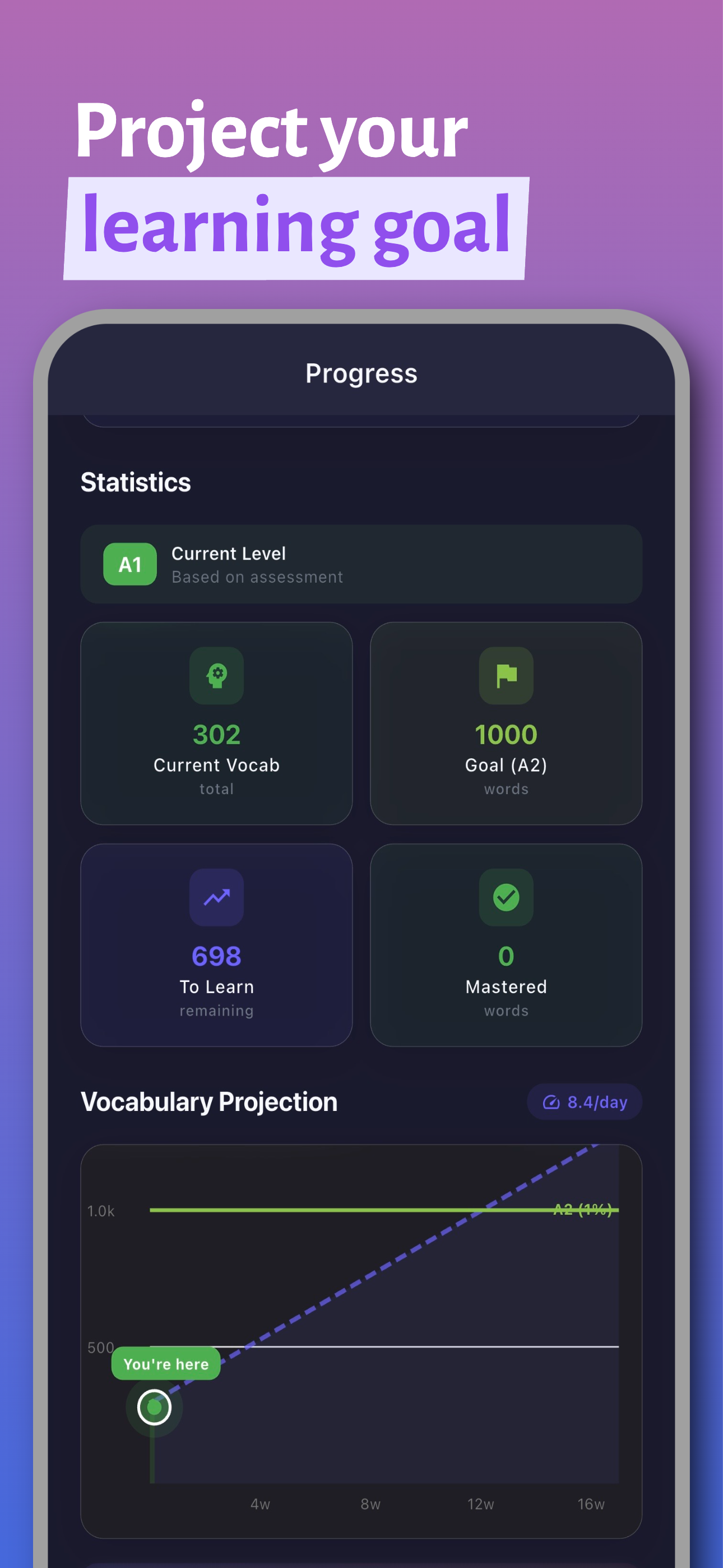
- A1 (Beginner): ~500 words. You can handle basic greetings, order food, and introduce yourself.
- A2 (Elementary): ~1,000 words. You can manage routine conversations and understand common phrases.
- B1 (Intermediate): ~2,000 words. You can handle most daily situations and understand the main points of clear speech.
- B2 (Upper Intermediate): ~4,000 words. You can interact with native speakers with reasonable fluency.
- C1 (Advanced): ~8,000+ words. You can express yourself fluently and spontaneously on complex topics.
This does not mean grammar is irrelevant. It means that building your word count delivers the fastest return on your study time, especially in the early stages.
5 Proven Techniques to Learn Spanish Vocabulary Fast
Not all study methods are created equal. Here are the five that produce measurable results, ranked by their impact on long-term retention.
1. Spaced Repetition: The Memory Multiplier
Spaced repetition is the single most powerful technique for vocabulary retention. Instead of reviewing every word every day, you review each word at scientifically optimal intervals: just before your brain would forget it.
The intervals expand over time. You might see a new word after 1 day, then 3 days, then 7 days, then 21 days, then 60 days. Each successful recall strengthens the memory trace, and the algorithm adapts to your individual performance. Words you find easy get pushed further out. Words you struggle with come back sooner.
Research from the Journal of Experimental Psychology shows that spaced repetition can improve long-term retention by over 200% compared to massed practice (cramming). That is not a small difference. It is a fundamentally different approach to how memory works.
2. Active Recall: Test Yourself, Do Not Just Review
Active recall means retrieving information from memory rather than simply recognizing it. Instead of looking at “casa = house” and moving on, you see “casa” and actively try to produce the meaning before checking.
This feels harder. That is exactly why it works. The act of struggling to recall a word strengthens the neural pathways associated with that memory far more effectively than passive review. Cognitive psychologists call this the testing effect, and it is one of the most robust findings in learning science.
A 2011 study in Science by Karpicke and Blunt found that students who practiced active recall retained 50% more material than those who used other study techniques, including concept mapping and rereading.
3. Context-Based Learning: Words in Their Natural Habitat
Isolated word lists are the least effective way to learn vocabulary. When you learn “mesa” alongside “La mesa está en la cocina” (The table is in the kitchen), you create multiple memory hooks: the word itself, its grammatical context, and the visual scene it evokes.
Organizing words by topic and category further strengthens these associations. Learning kitchen vocabulary together (mesa, silla, cocina, nevera, plato) creates a semantic network where each word reinforces the others.
4. The 5-Minute Daily Habit: Consistency Over Intensity
One of the most common mistakes in language learning is the boom-and-bust cycle: studying for two hours on Saturday, then doing nothing for the rest of the week. Research on habit formation and memory consolidation consistently shows that short daily sessions dramatically outperform long infrequent ones.
Five minutes of focused vocabulary practice every day beats one 35-minute session per week, even though the total time is less. Why? Because each session triggers a new consolidation cycle during sleep. Seven consolidation cycles per week embed words far more deeply than one.
The 5-Minute Rule: If you can commit to just 5 minutes of vocabulary practice every day, you will learn approximately 10-15 new words daily. That is 300-450 words per month, or roughly 3,600-5,400 per year. Enough to reach B2 level in under 12 months.
5. Category-Based Organization: Build Vocabulary Clusters
Your brain does not store words in alphabetical order. It stores them in semantic clusters: groups of related concepts that activate together. When you think “kitchen,” your brain automatically primes related words like stove, fridge, and fork.
Organizing your study sessions by topic leverages this natural architecture. Instead of learning 20 random words, learn 20 words about food, or travel, or daily routines. The built-in associations make each word easier to store and retrieve.
How Spaced Repetition Supercharges Memory
In 1885, German psychologist Hermann Ebbinghaus discovered something that would eventually revolutionize how we learn: the forgetting curve. Through meticulous self-experimentation, he showed that without reinforcement, we forget approximately 70% of new information within 24 hours, and over 90% within a week.
That sounds discouraging, but Ebbinghaus also discovered the solution. Each time you successfully review information at the right moment, the forgetting curve flattens. The memory becomes more durable, and the interval before you need to review again gets longer.
Modern spaced repetition systems (SRS) automate this process using algorithms that track your performance on each individual word. The system knows which words you find easy (and can wait longer before testing you again) and which you find difficult (and need to review sooner).
The practical result is striking. Research by Bahrick et al. showed that material learned through spaced intervals was retained for years, while material crammed in a single session was mostly forgotten within weeks. A 2016 meta-analysis in Psychological Bulletin confirmed that spaced practice produces a 200% improvement in long-term retention compared to massed practice across hundreds of studies and thousands of participants.
This is not a small optimization. It is the difference between words that fade from memory in days and words that stay with you for life.
Building Your Daily Vocabulary Routine
The best vocabulary routine is the one you actually do every day. Here is a practical template that fits into any schedule and maximizes retention per minute spent:
The Morning Micro-Session (5-10 minutes)
- Review first (3-5 minutes): Start with words scheduled for review by your SRS system. These are words you have seen before and need to reinforce. This takes advantage of your fresh morning brain and consolidation from the previous night's sleep.
- Learn new words (2-5 minutes): After reviews, introduce 5-15 new words depending on your level. Focus on words from a single category or topic to create those natural memory clusters.
- Quick self-test: At the end, mentally recall 3-5 of the new words you just learned. This initial active recall primes them for the spaced repetition cycle.
The Optional Evening Check-in (2-3 minutes)
If you can spare an extra 2-3 minutes before bed, do a quick review of the words you learned that morning. Research on sleep consolidation suggests that reviewing material shortly before sleep enhances the brain's overnight memory processing. This is not essential, but it can significantly speed up your progress.
Weekly Progress Check
Once a week, take a few minutes to check your stats. How many total words do you know? What is your retention rate? Are certain categories harder than others? This is not vanity. Tracking your progress is one of the strongest predictors of continued motivation and success in language learning.
Setting Realistic Goals with CEFR Levels
The CEFR framework gives you concrete milestones to aim for. Here are realistic timelines based on 10-15 minutes of daily practice:
- A1 (500 words): 1-2 months. You will be able to handle basic tourist situations, greet people, and order food.
- A2 (1,000 words): 3-4 months. You can manage routine conversations about familiar topics and understand simple texts.
- B1 (2,000 words): 6-8 months. You can handle most situations you might encounter while traveling and describe experiences and events.
- B2 (4,000 words): 12-16 months. You can interact with native speakers without strain and understand complex texts on both concrete and abstract topics.
These timelines assume consistent daily practice with an effective method like spaced repetition. With less effective methods, multiply the timelines by 2-3x. With more time per day, you can compress them significantly.
The key insight is that reaching conversational fluency (B1-B2) does not require years of study. It requires consistent daily effort combined with the right technique.
Follow @vocaswipe on TikTok
Daily Spanish words, pronunciation tips, and vocabulary challenges.
Put these techniques into practice
VocaSwipe automates spaced repetition and active recall so you can focus on learning. Track your CEFR progress and build vocabulary in just 5 minutes a day.
Key Takeaways
- Vocabulary is the foundation of fluency. Just 2,000 words cover 80% of everyday Spanish conversation.
- Spaced repetition is the most efficient method. It improves long-term retention by over 200% compared to traditional study.
- Active recall beats passive review. Testing yourself strengthens memory far more than rereading word lists.
- 5 minutes daily beats 2 hours weekly. Consistency and sleep consolidation make short daily sessions more effective.
- Organize by category. Learning words in semantic clusters matches how your brain naturally stores information.
- Set CEFR-based milestones. Concrete word-count goals (500, 1,000, 2,000, 4,000) give you measurable targets to work toward.
Frequently Asked Questions
How many Spanish words should I learn per day?
For sustainable progress, aim for 10-20 new words per day combined with review of previously learned words. Beginners should start with 5-10 words and gradually increase. Quality matters more than quantity. It is better to truly know 10 words than to half-learn 50. With spaced repetition, you can comfortably learn 15 new words daily while reviewing 30-50 older words in a single 10-minute session.
What is the fastest way to build Spanish vocabulary?
The fastest evidence-based method combines three techniques: spaced repetition (reviewing words at scientifically optimal intervals), active recall (testing yourself rather than passively reading), and context-based learning (learning words in meaningful phrases and categories). Consistency beats intensity. Ten minutes daily outperforms two-hour weekend sessions because each session triggers a new memory consolidation cycle during sleep.
Do flashcard apps really work for language learning?
Yes, when they use spaced repetition algorithms. Research published in the Journal of Experimental Psychology shows that spaced repetition flashcards improve long-term retention by over 200% compared to traditional study methods. The key is that modern flashcard apps schedule reviews based on your individual memory patterns, showing you words right before you would forget them. This is far more effective than flipping through a static deck repeatedly.