Here is the good news about Spanish pronunciation: it is one of the most phonetically consistent languages on earth. Unlike English, where “ough” can be pronounced at least six different ways, Spanish follows clear, predictable rules. Once you learn how each letter sounds, you can pronounce virtually any word you encounter, even if you have never seen it before.
The bad news is that a handful of sounds do not exist in English, and getting them wrong can change the meaning of a word entirely. “Pero” (but) and “perro” (dog) differ by a single sound. “Año” (year) and “ano” (well, look it up) are separated by one small squiggle.
This guide covers every sound you need to master, from the five vowels that form the backbone of Spanish to the tricky consonants that trip up English speakers. We will also explore how pronunciation varies across regions and give you practical strategies for training your ear and mouth.
Hear every word pronounced by native speakers
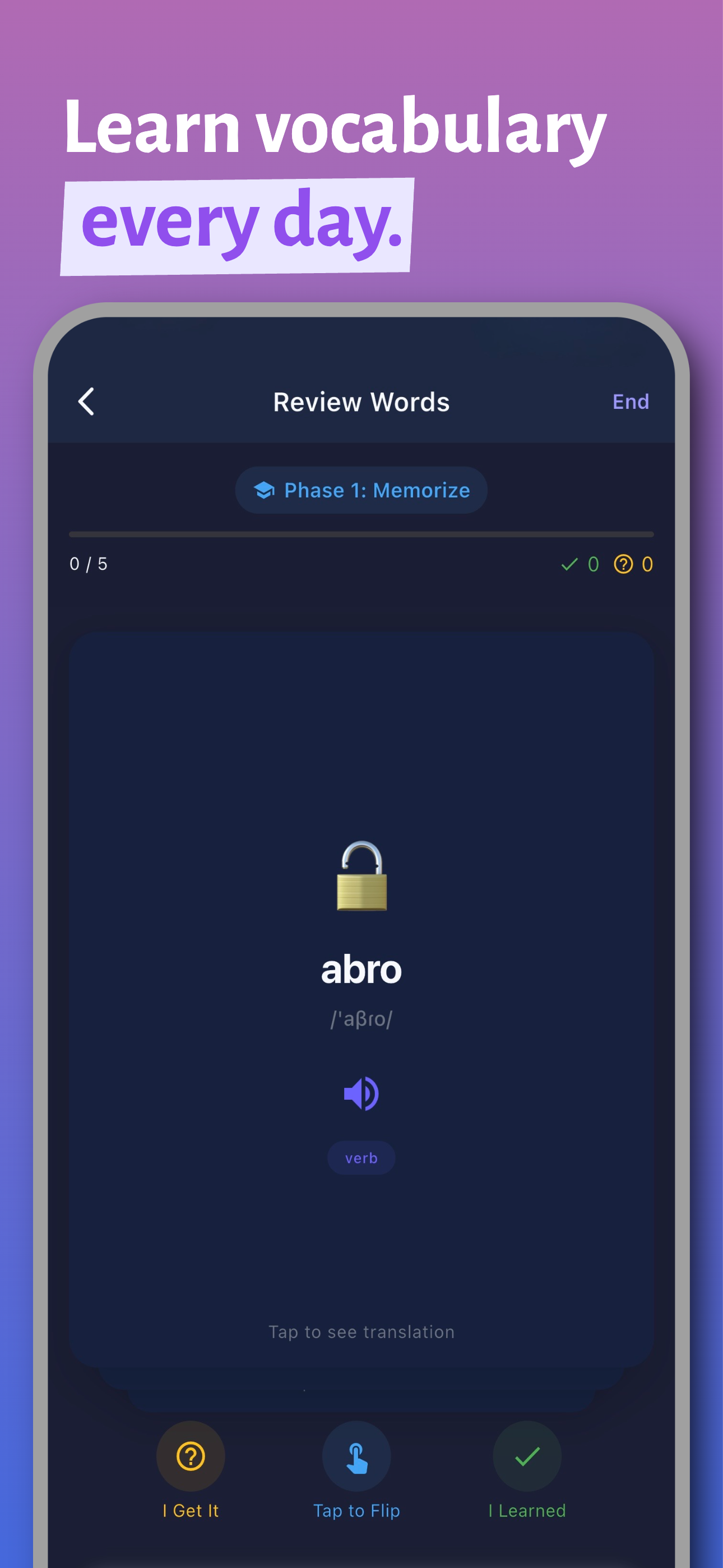
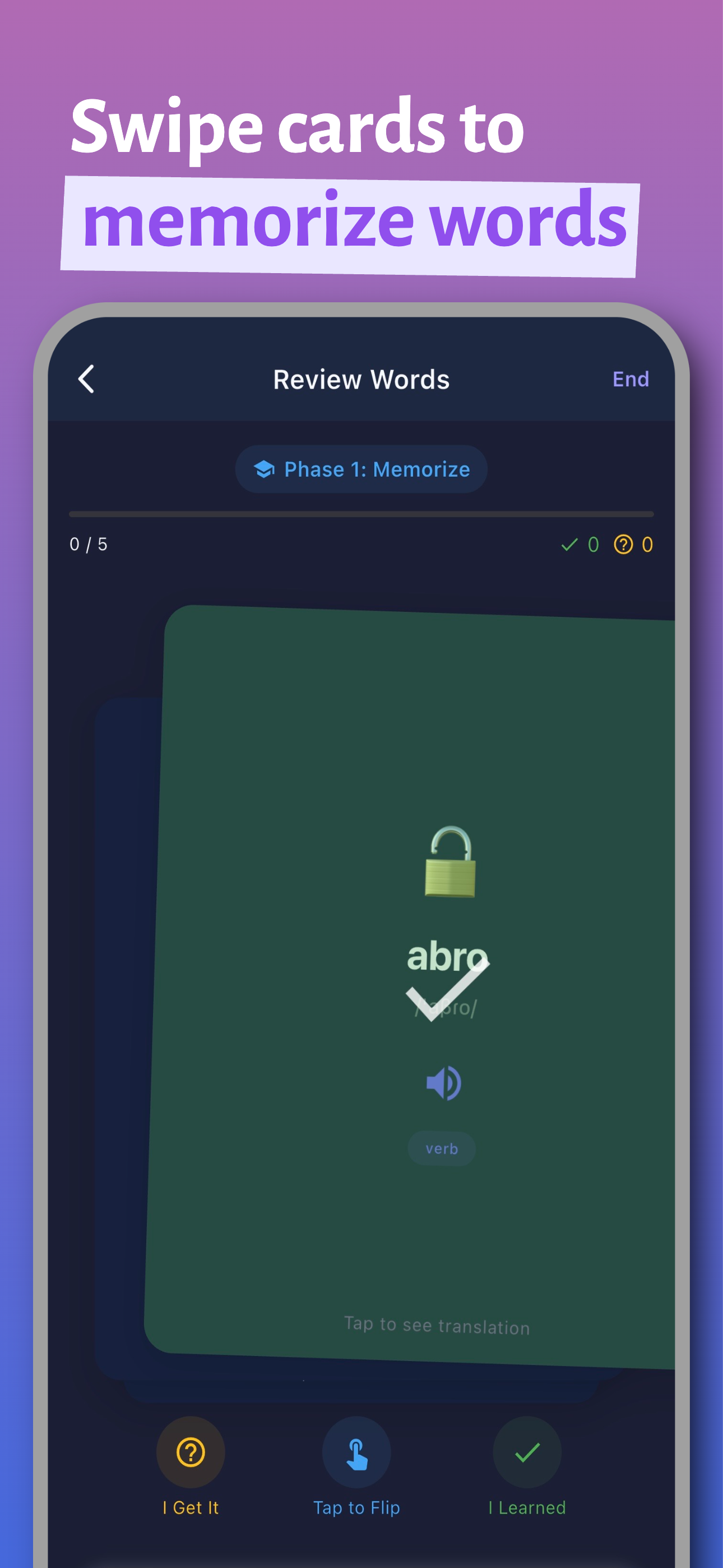
VocaSwipe includes audio playback for every flashcard so you can train your ear while building vocabulary. 5 minutes a day.
The Five Vowels: The Foundation of Spanish Sound
Spanish has exactly five vowel sounds. English has somewhere between twelve and fifteen, depending on your dialect. This simplicity is a gift. Once you internalize these five sounds, you have the foundation for every Spanish word.
- A — always sounds like the “a” in “father.” Never changes. Casa, mapa, hablar.
- E — sounds like the “e” in “bed.” Short and clean. Mesa, verde, leche.
- I — sounds like the “ee” in “see.” Always this sound, never the English “eye” sound. Si, vino, libro.
- O — sounds like the “o” in “more” but shorter. No glide into “oo.” Solo, como, otro.
- U — sounds like the “oo” in “food.” Uno, luna, azul.
The critical difference from English: Spanish vowels are pure. They do not glide or shift. When an English speaker says “no,” the vowel slides from “o” toward “oo.” In Spanish, the “o” in “no” stays perfectly still. Keeping your vowels short and steady is the single fastest way to sound less foreign.
Tricky Consonants That Trip Up English Speakers
Most Spanish consonants behave similarly to English ones. The following are the exceptions that require deliberate practice.
The Rolled RR
The rr (as in perro, carro, correr) is a trilled sound produced by vibrating the tip of your tongue against the ridge behind your upper teeth. It does not exist in standard English, which is why it is the sound most English speakers struggle with.
A practical tip: try saying “butter” or “ladder” very quickly in American English. The quick “dd” or “tt” flap is close to the Spanish single r (a tap). The trilled rr is that same motion repeated rapidly. Start by practicing the single tap, then try to sustain it into a trill.
The Jota (J and G before E/I)
The Spanish j (and g before e or i) is a guttural, raspy sound produced in the back of the throat. Think of it as a stronger, rougher version of the “h” in “hello.” In words like jardin, gente, and joven, this sound has no English equivalent. In some Latin American dialects it softens to a simple “h” sound, while in Castilian Spanish it is stronger and more throaty.
The LL and Y
In most modern Spanish dialects, ll and y are pronounced the same way, a phenomenon called yeísmo. In Mexico and most of Latin America, both sound like the English “y” in “yes.” In Argentina and Uruguay, they shift to a “sh” or “zh” sound, so calle sounds more like “CA-she.”
The Ñ
The ñ sounds like the “ny” in “canyon.” Your tongue presses broadly against the roof of your mouth. España, año, niño, señor. This one is not difficult once you realize it is the same sound you already make in English words like “onion” or “canyon.”
C and Z: The Castilian Split
In Latin American Spanish, c (before e/i) and z are both pronounced as “s.” In Castilian Spanish (Spain), they are pronounced like the English “th” in “think.” This is the famous distinction (distinción) that gives Castilian its characteristic sound. Cerveza becomes “ther-VEH-tha” in Madrid but “ser-VEH-sa” in Mexico City.
B and V
In Spanish, b and v are pronounced identically. Both produce a soft sound somewhere between the English “b” and “v” when they appear between vowels. At the start of a phrase or after “m” or “n,” both are a firm “b.” Native speakers cannot distinguish “vaca” from “baca” by sound alone. Do not try to differentiate them.
D: The Disappearing Consonant
Between vowels, the Spanish d softens to a sound similar to the “th” in “this” (not “think”). In casual speech, it often disappears entirely. Cansado becomes “can-SAH-oh” and hablado becomes “ah-BLAH-oh” in everyday conversation. This is completely normal and not lazy speech.
G: Two Sounds
Before a, o, u, the letter g sounds like the English “g” in “go.” Before e or i, it sounds like the Spanish j (the guttural sound described above). To get the hard “g” sound before e or i, Spanish adds a silent u: guerra, guitarra.
Stress Rules: Where to Put the Emphasis
Spanish stress rules are refreshingly logical. There are only three rules, and they cover every word in the language:
- Words ending in a vowel, n, or s: stress the second-to-last syllable. Ca-SA, ha-BLAN, pa-LA-bras.
- Words ending in a consonant (except n or s): stress the last syllable. ha-BLAR, ciu-DAD, es-pa-ÑOL.
- Exceptions carry an accent mark: if a word breaks either rule above, an accent mark tells you exactly where the stress falls. cafÉ, telÉ-fo-no, rÁ-pi-do.
This means that if you see a written accent mark, stress that syllable. If you do not see one, apply rules one and two. That is it. No guessing required.
Pro tip: Getting stress wrong changes meaning. “Papa” (potato) vs. “papá” (dad). “Hablo” (I speak) vs. “habló” (he spoke). Always pay attention to accent marks.
Regional Accents: Four Major Varieties
Spanish is spoken natively by over 500 million people across more than 20 countries. Naturally, pronunciation varies. Here are the four major accent groups you will encounter:
Castilian (Spain)
Characterized by the distinción (the “th” sound for c/z), the use of vosotros, and a slightly more clipped, energetic rhythm. The s at the end of syllables is crisp and fully pronounced. Madrid and northern Spain are considered the standard bearers of this accent.
Mexican
Often considered the “neutral” Latin American accent due to its prevalence in media. No distinción, clear pronunciation of all syllables, moderate pace. Mexican Spanish tends to be very clear and is widely recommended for beginners because of its consistency and the sheer volume of learning resources available.
Rioplatense (Argentina and Uruguay)
The most distinctive Latin American accent. The ll and y shift to a “sh” or “zh” sound. The pronoun vos replaces tú with its own verb conjugations. The intonation is melodic and often compared to Italian, reflecting the heavy Italian immigration to the region.
Caribbean (Cuba, Dominican Republic, Puerto Rico, coastal areas)
Fast-paced and musical. The s at the end of syllables is aspirated (sounds like a soft “h”) or dropped entirely: estos becomes “EH-toh.” The r at the end of words sometimes shifts toward an “l” sound. Caribbean Spanish can sound quite different from textbook pronunciation, but understanding it becomes natural with exposure.
The key point: all these dialects are mutually intelligible. Learning any one of them prepares you to understand all of them. Most learners pick the accent that matches their goals. Planning to travel to Spain? Focus on Castilian. Moving to Mexico? Learn Mexican pronunciation. Consuming Argentine media? Embrace the Rioplatense sound.
IPA Basics for Spanish Learners
The International Phonetic Alphabet (IPA) gives every sound a unique symbol, removing ambiguity. You do not need to memorize the entire IPA system, but knowing a few key symbols helps when using dictionaries or pronunciation guides:
- /a/ — the Spanish “a” (open central vowel)
- /e/ — the Spanish “e” (mid front vowel)
- /i/ — the Spanish “i” (close front vowel)
- /o/ — the Spanish “o” (mid back vowel)
- /u/ — the Spanish “u” (close back vowel)
- /r/ — the single tap (as in pero)
- /r̩/ or /rr/ — the trilled r (as in perro)
- /x/ — the jota sound (as in jardín)
- /ɲ/ — the ñ sound (as in año)
When you encounter a new word while building your vocabulary, checking its IPA transcription can instantly clarify pronunciation when audio is not available. But for daily practice, listening to native audio and repeating is more effective than reading transcriptions.
Follow @vocaswipe on TikTok
Daily pronunciation tips, Spanish words of the day, and quick accent comparisons.
How to Practice Pronunciation Effectively
Reading about pronunciation is useful, but the real progress comes from practice. Here are strategies that deliver results:
- Listen and repeat: Use flashcard apps with native audio, like VocaSwipe, to hear each word pronounced correctly and then say it out loud. Repetition builds the muscle memory your mouth needs.
- Record yourself: Use your phone to record yourself saying Spanish words and sentences. Compare your recording to native audio. You will hear differences you cannot detect in real time.
- Shadow native speakers: Play a Spanish podcast or video and try to speak along simultaneously, matching their rhythm, intonation, and pronunciation as closely as possible.
- Focus on problem sounds: Identify the 2-3 sounds you struggle with most and dedicate a few minutes daily to words that contain them. Targeted practice is far more efficient than general repetition.
- Engage with real conversations: Even short exchanges with native speakers force you to produce sounds under real conditions, which accelerates improvement far beyond solo practice.
The key is consistency. Five minutes of daily pronunciation practice, even just repeating words as you learn new vocabulary, compounds into dramatic improvement over weeks and months.
Learn pronunciation while building vocabulary
Every VocaSwipe flashcard includes native audio so you can practice pronunciation and vocabulary simultaneously. Swipe your way to fluency.
Key Takeaways
- Spanish is highly phonetic. Words are pronounced as they are spelled, making it one of the easiest languages to pronounce once you learn the rules.
- Master the five pure vowels first. They are the foundation of every Spanish word and the fastest way to reduce a foreign accent.
- Focus on the rr, j, and ñ. These are the sounds that do not exist in English and require deliberate practice.
- Stress rules are logical. Three simple rules plus accent marks cover every word in the language.
- All dialects are mutually intelligible. Pick the accent that matches your goals, but know that learning one prepares you for all.
- Practice with audio daily. Listening and repeating builds the muscle memory that reading alone cannot provide.
Frequently Asked Questions
Is Spanish pronunciation easy?
Spanish is one of the most phonetically consistent languages in the world. Unlike English, Spanish words are almost always pronounced exactly as they are spelled. Once you learn the sound each letter makes, you can pronounce nearly any word correctly on your first try. The main challenges are the rolled rr, the ñ sound, and learning where to place stress, but with regular practice these become natural within a few weeks.
What is the hardest Spanish sound for English speakers?
The rolled rr (as in perro or carro) is consistently rated as the most difficult Spanish sound for English speakers. It requires a tongue trill that does not exist in English. The single r is also tricky because it is a quick tap of the tongue against the roof of the mouth, different from the English r. Other challenging sounds include the jota (j) and the ñ as in año. Regular listening practice and repeating words with audio playback helps build muscle memory for these sounds.
What is the difference between Spanish in Spain vs Mexico?
The most noticeable difference is the Castilian distinción: in Spain, the letters c (before e/i) and z are pronounced like the English “th” in “think,” while in Mexico they are pronounced as a regular “s.” Spain also uses vosotros (informal plural “you”) while Mexico uses ustedes for both formal and informal. Vocabulary differs too. However, all Spanish dialects are mutually intelligible, so learning one prepares you for all of them.