Everyone starts learning Spanish with enthusiasm. You download an app, learn “hola” and “gracias,” and feel a surge of excitement. After a few weeks, you can count to twenty, introduce yourself, and order a coffee. Progress feels effortless.
Then month three arrives. New grammar concepts feel impenetrable. Conversations with native speakers reveal enormous gaps. You understand maybe 20% of a Spanish podcast. The exciting novelty has faded, but fluency feels impossibly far away. So you skip a day. Then two. Then a week. And quietly, without any dramatic decision, you stop.
This pattern is so common it has a name: the intermediate plateau. Research suggests that roughly 90% of language learners quit before reaching conversational fluency, and most of them quit right here. Not because they lack talent, but because they lack a strategy for navigating this predictable phase.
This article gives you that strategy. We will break down the motivation curve, then walk through eight evidence-based techniques for pushing through the plateau and building a sustainable daily practice that lasts.
Build a streak that keeps you going
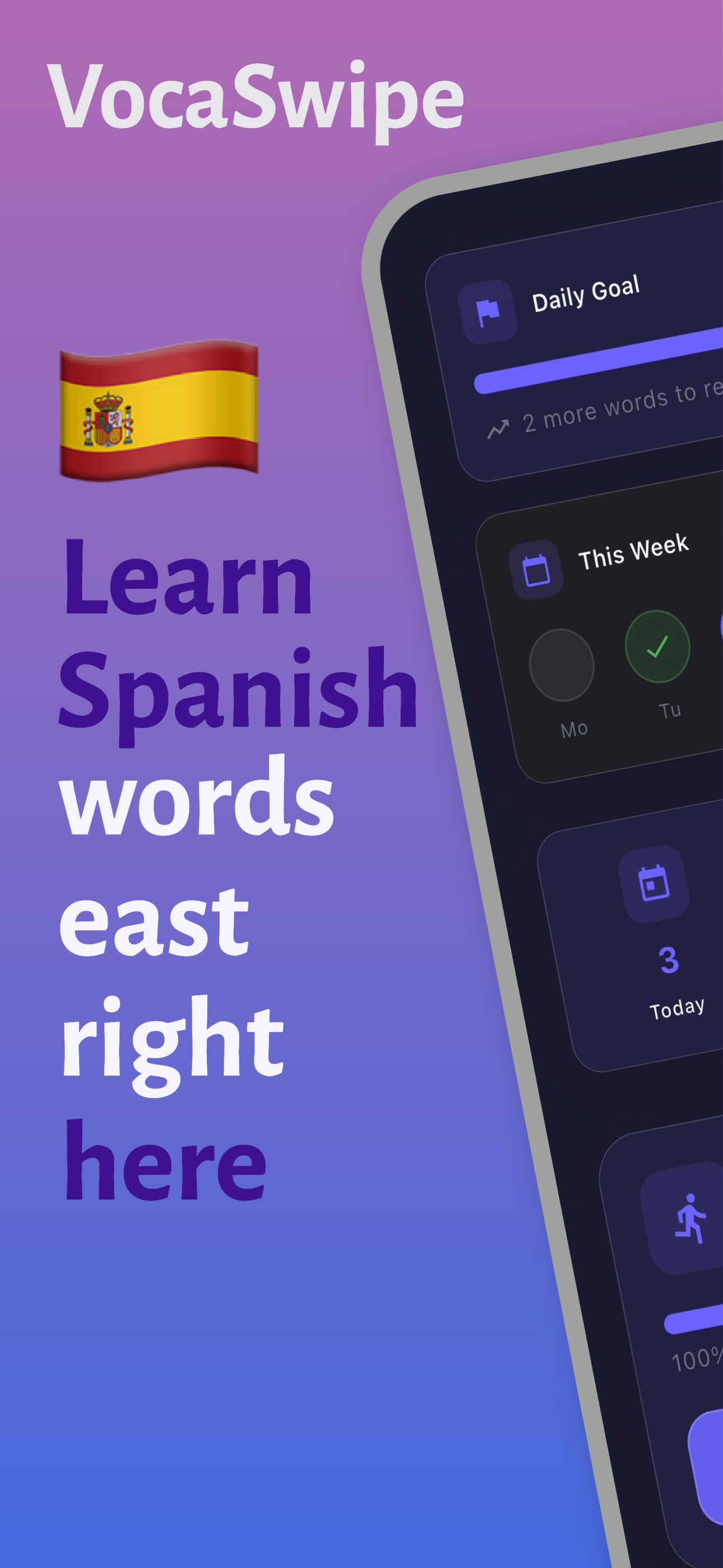
VocaSwipe tracks your daily streak, awards badges, and shows your real progress. 5 minutes a day builds unstoppable momentum.
The Motivation Curve: Honeymoon, Plateau, Breakthrough
Understanding the motivation curve removes its power to derail you. Every language learner passes through three predictable phases:
Phase 1: The Honeymoon (Weeks 1-6)
Everything is new and exciting. You pick up words quickly because your brain is wired to pay attention to novelty. Each session delivers visible progress. Your word count grows daily. Simple sentences click into place. You feel like a natural.
The danger here is not lack of motivation. It is overconfidence. Many learners commit to unsustainable routines during this phase (an hour a day, multiple apps, nightly vocabulary lists) that collapse the moment novelty fades.
Phase 2: The Plateau (Months 2-6)
The low-hanging fruit is gone. New concepts require more effort per unit of progress. Grammar exceptions pile up. You understand written Spanish better than spoken Spanish, and the gap feels discouraging. Real conversations expose how much you still do not know.
This is where 90% of learners quit. The crucial thing to understand is that the plateau is not a sign that you are failing. It is a sign that you have graduated from beginner content and are now doing the harder work of building real competence. Progress has not stopped. It has become less visible.
Phase 3: The Breakthrough (Months 6+)
If you survive the plateau, something remarkable happens. Vocabulary starts connecting into networks. Grammar rules you memorized months ago begin to feel automatic. You catch phrases in songs, follow podcast conversations, and think in Spanish without translating first. Motivation surges back because progress is visible again.
The breakthrough does not arrive on a specific date. It accumulates gradually until one day you realize you understood an entire conversation without consciously translating. The only way to reach this phase is to keep showing up during the plateau.
8 Strategies That Keep You Going
1. Set Micro-Goals, Not Mega-Goals
“Become fluent in Spanish” is not a goal. It is a fantasy with no actionable steps. Micro-goals are specific, achievable targets you can hit this week: learn 20 food words, understand one paragraph of a news article, hold a 30-second conversation about the weather.
Micro-goals work because they give you frequent wins. Each completed goal produces a small dopamine hit that fuels the next one. Over months, these micro-goals compound into major progress that a single vague goal never could.
2. Protect Your Streak
Streaks are one of the most powerful behavioral tools in language learning, and the research backs this up. Studies on habit formation show that the most important factor in building a lasting habit is frequency, not duration. A 30-day streak of 5-minute sessions builds a stronger neural pathway than sporadic hour-long study sessions.
Streaks also leverage loss aversion, the psychological principle that losing something hurts more than gaining the same thing feels good. After 15 days of consecutive practice, the thought of breaking your streak becomes a powerful motivator, even on days when enthusiasm is low.
The Minimum Viable Session: On your worst days, do the absolute minimum. One review session. Five flashcards. Two minutes. The goal is not to learn anything. The goal is to not break the streak. Tomorrow will be better.
3. Connect to Your Purpose
Abstract motivation (“Spanish would be nice to know”) collapses under pressure. Concrete motivation survives. Write down your specific reason for learning Spanish and put it where you will see it daily: a trip to Barcelona next summer, a partner's family who speaks Spanish, a job that requires bilingual skills, a love of Latin American literature in the original language.
Research by Dörnyei on language learning motivation consistently shows that learners with a vivid “future self-image” of themselves as Spanish speakers persist significantly longer than those with vague goals.
4. Optimize Difficulty: The Sweet Spot
Psychologist Mihaly Csikszentmihalyi's research on flow states shows that engagement peaks when the challenge slightly exceeds your current ability, roughly 4% harder than what you can comfortably do. Too easy and you are bored. Too hard and you are frustrated.
In language learning, this means constantly adjusting your material. If flashcard reviews feel mindless, add harder words. If every sentence in your Spanish podcast is incomprehensible, find one at a lower level. The sweet spot is where you understand about 70-80% and have to work for the rest.
5. Use Gamification Strategically
Gamification is not about turning learning into a game. It is about leveraging the same psychological mechanisms that make games compelling: clear progress indicators, immediate feedback, meaningful rewards, and a sense of advancement.
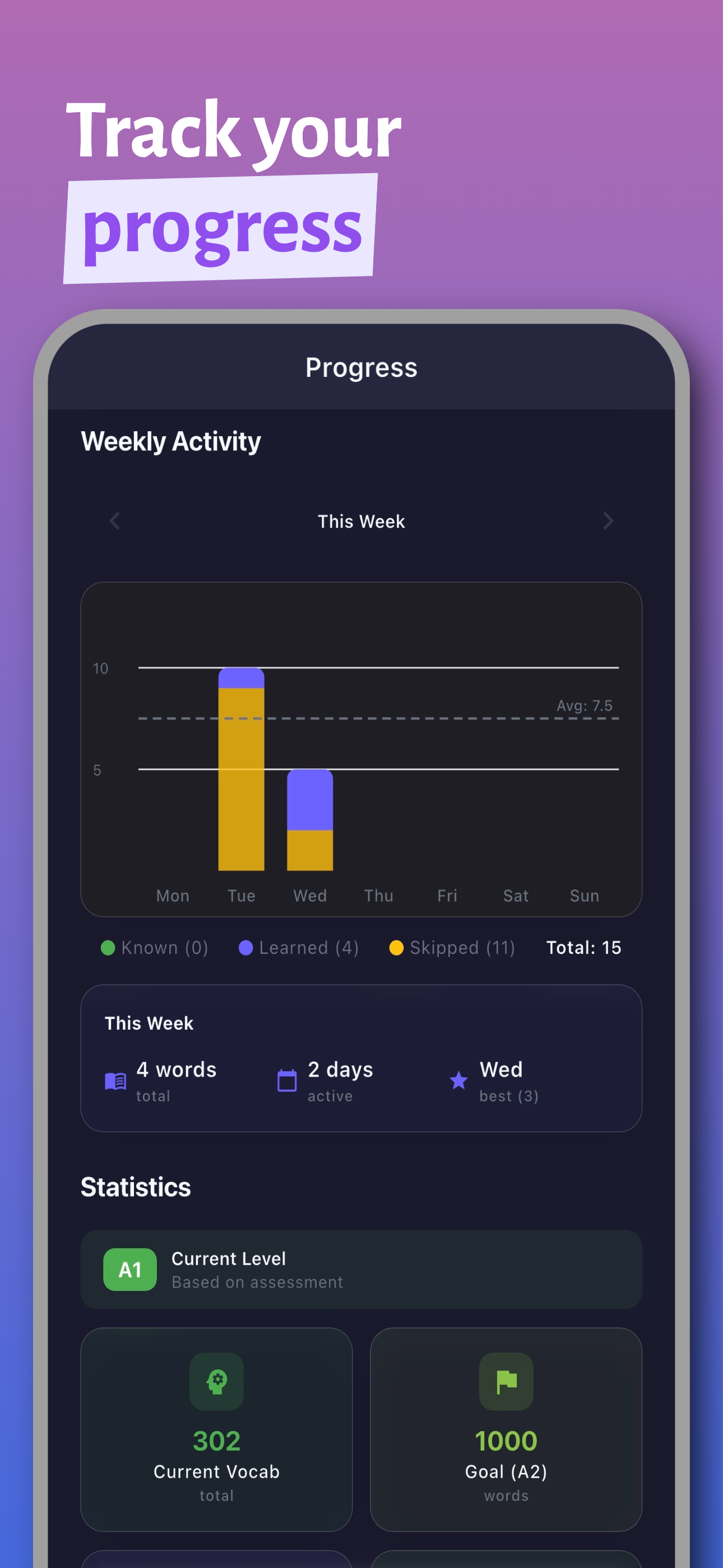
Badges for milestones (100 words learned, 7-day streak, first category completed) provide tangible evidence of progress that raw word counts cannot. VocaSwipe's badge and progress system is designed around this principle: every achievement represents real linguistic growth, not arbitrary points.
6. Build a Community Connection
Language learning in isolation is harder than it needs to be. Even minimal social connection, a study partner, an online forum, a language exchange, creates accountability and normalizes the struggle. Knowing that other people hit the same plateau and pushed through it is surprisingly motivating.
You do not need to join a class or find a tutor (though both help). Following Spanish learning communities on social media, participating in challenges, or simply sharing your streak with a friend can provide enough social reinforcement to keep you going.
7. Immerse Through Media You Enjoy
Forced immersion through boring textbook exercises kills motivation. Voluntary immersion through content you genuinely enjoy sustains it. The key word is enjoy. If you like true crime, listen to Spanish true crime podcasts. If you like cooking, watch Mexican cooking channels on YouTube. If you like music, build a Spanish playlist and look up lyrics.
This kind of immersion does not feel like studying, which is exactly why it works during the plateau phase when traditional study feels like a chore. You are still acquiring vocabulary and training your ear, but the experience is driven by interest rather than obligation.
8. Remember Your Why on Hard Days
Keep a “wins journal” where you record moments of real progress: the first time you understood a Spanish joke, the conversation where you did not need Google Translate, the song lyric that suddenly made sense. On days when motivation is low, read through these entries. They are concrete proof that your effort is working, even when daily progress feels invisible.
Follow @vocaswipe on TikTok
Daily motivation, Spanish word challenges, and progress celebrations from learners worldwide.
Make progress you can actually see
VocaSwipe tracks your streak, awards badges for real milestones, and shows exactly how your vocabulary is growing. Motivation built into every swipe.
Key Takeaways
- The plateau is predictable, not personal. Nearly every learner hits it around months 2-6. Knowing it is coming helps you prepare.
- Micro-goals beat mega-goals. Frequent small wins sustain motivation far better than distant large objectives.
- Streaks build habits, not just numbers. Daily consistency creates neural pathways that make practice automatic.
- Concrete purpose outlasts abstract interest. Know exactly why you are learning and revisit that reason regularly.
- Enjoy your immersion. Spanish media you genuinely like sustains learning through phases when textbooks feel like punishment.
- The minimum viable session saves streaks. On bad days, two minutes of practice is infinitely better than zero.
Frequently Asked Questions
Why do people quit learning Spanish?
Most people quit during the intermediate plateau, typically 3-6 months into learning. At the beginner stage, progress is rapid and exciting. But once the basics are covered, progress slows dramatically. New grammar feels harder, conversations expose gaps, and the novelty wears off. Research suggests around 90% of language learners quit before reaching conversational fluency. The key to pushing through is understanding that the plateau is a normal, predictable phase, not a sign of failure.
How do I get past the intermediate plateau?
The intermediate plateau breaks when you shift from studying about the language to using the language. Start consuming Spanish media you actually enjoy. Set micro-goals that focus on real-world tasks rather than abstract knowledge: order coffee in Spanish, understand one song lyric, have a 2-minute conversation. Track your progress with metrics that capture growth (total words known, streak length) rather than measuring yourself against fluency. Most importantly, reduce session length to maintain consistency. Five minutes daily beats 30 minutes twice a week.
Do streaks actually help language learning?
Yes, streaks are one of the most effective behavioral tools for language learning. The value of a streak is not the streak itself but the daily consistency it creates. Research on habit formation shows that the most important factor in building a lasting habit is frequency, not duration. A 30-day streak of 5-minute sessions builds a stronger habit than sporadic hour-long study sessions. Streaks also leverage loss aversion, the psychological pain of breaking a streak motivates continued practice even on days when motivation is low.