“How long will it take me to learn Spanish?” It is the first question every new learner asks, and the answer you get depends entirely on who you ask. Language schools say a few months. Marketing campaigns promise 30 days. Your friend who studied for three years says it takes forever.
The truth, as usual, is more nuanced. There is solid data on this question, and it points to a clear range of timelines depending on your goals, study habits, and starting point. This article breaks down the real numbers so you can plan accordingly.
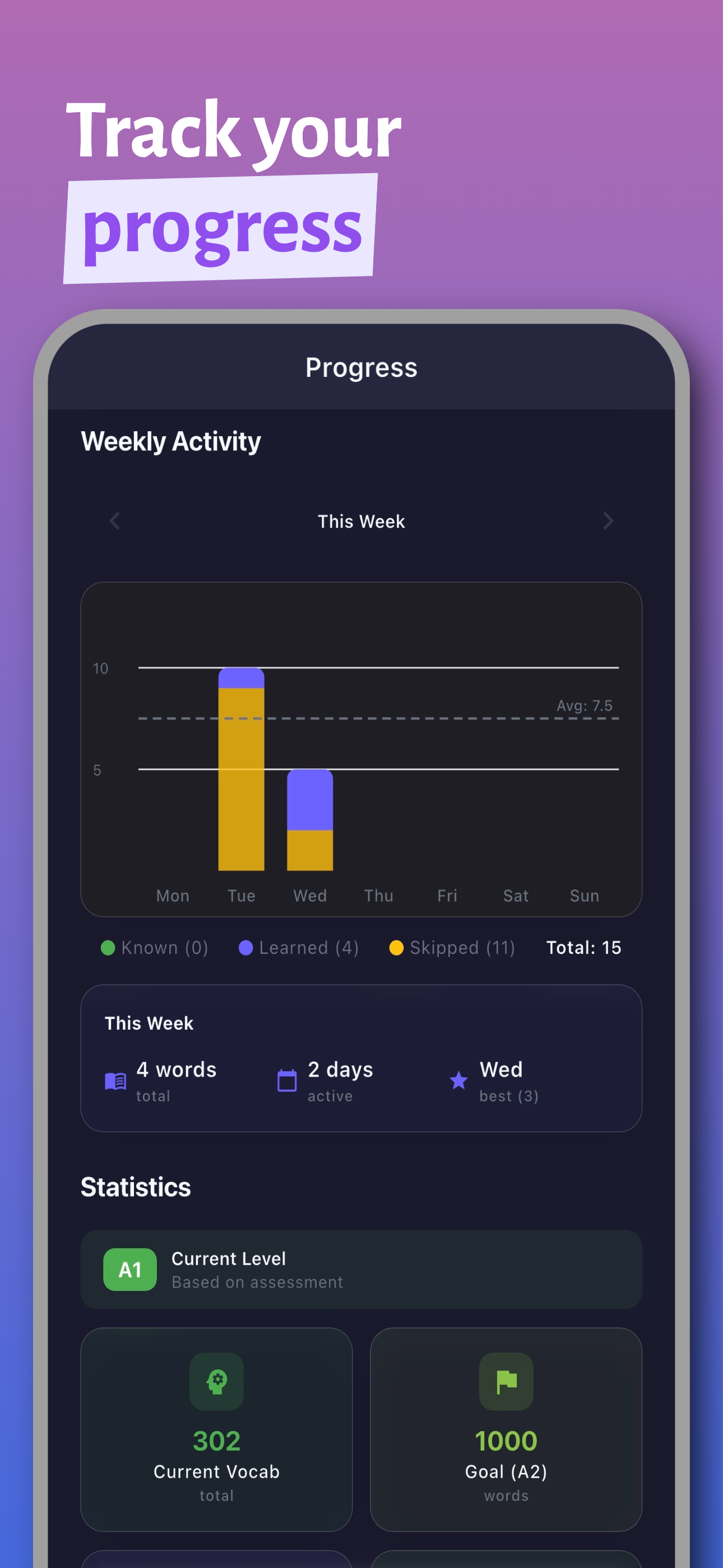
Track your progress toward fluency
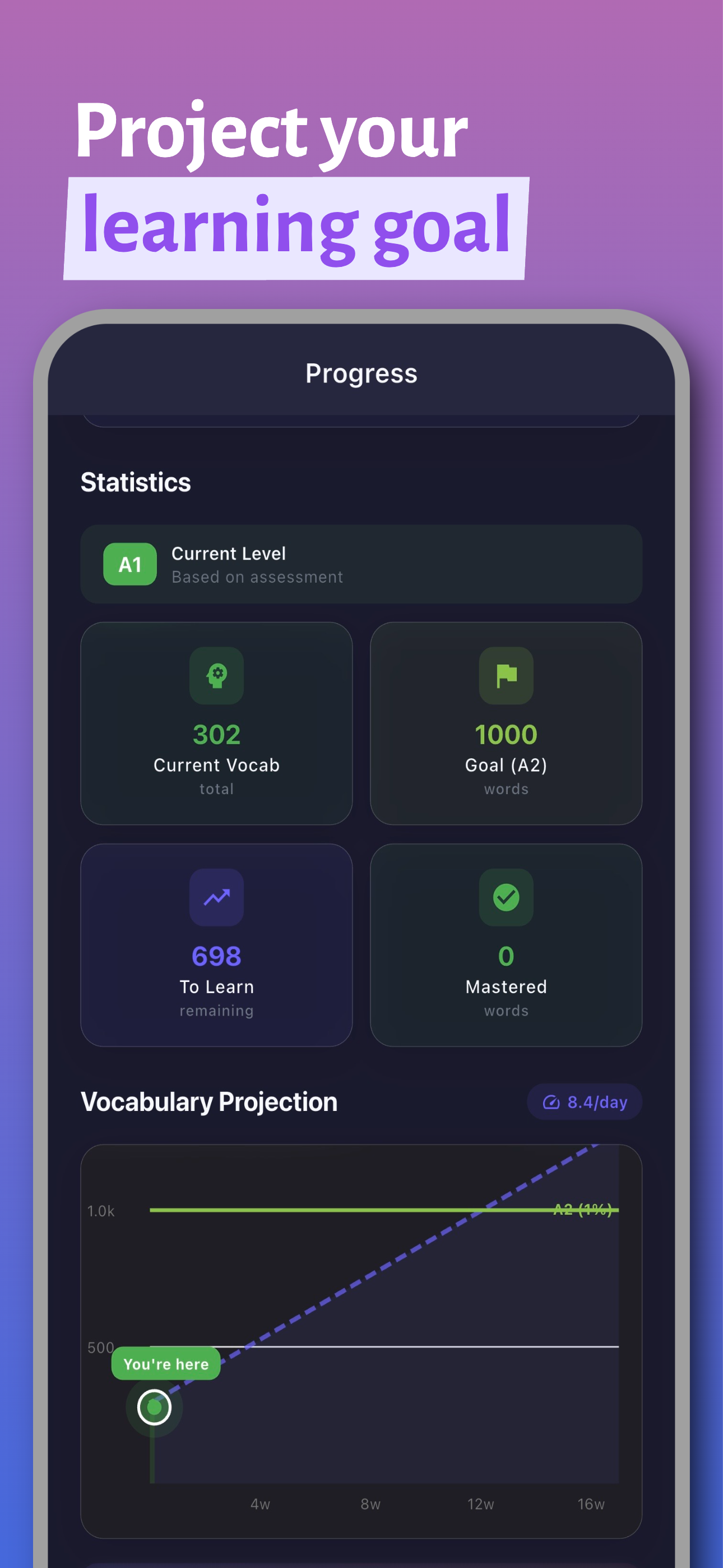
VocaSwipe projects your estimated time to each CEFR level based on your actual daily practice. Set goals and watch your vocabulary grow.
What the Data Says: The FSI Benchmark
The most cited source on language learning timelines comes from the U.S. Foreign Service Institute (FSI), which has been training diplomats in foreign languages for over 70 years. Based on decades of classroom data, the FSI classifies Spanish as a Category I language, meaning it is one of the easiest languages for English speakers to learn.
The FSI estimate for reaching “Professional Working Proficiency” in Spanish (roughly equivalent to CEFR B2/C1) is 600-750 classroom hours. This assumes intensive, structured study with professional instructors, not casual self-study.
For context, here is how Spanish compares to other popular languages:
- Spanish: 600-750 hours (Category I)
- French: 600-750 hours (Category I)
- German: 750-900 hours (Category II)
- Russian: 1,100 hours (Category III)
- Mandarin Chinese: 2,200 hours (Category IV)
- Japanese: 2,200 hours (Category IV)
Spanish is objectively one of the fastest languages for English speakers to pick up. Shared Latin vocabulary, consistent pronunciation rules, and relatively straightforward grammar all contribute to that advantage.
5 Factors That Determine Your Timeline
The FSI numbers are averages. Your actual timeline depends on several key variables.
1. Your Native Language
English speakers have a significant head start with Spanish. The two languages share thousands of cognates (words that look and sound similar): “hospital” is “hospital,” “important” is “importante,” “telephone” is “teléfono.” If you already speak another Romance language like French, Italian, or Portuguese, your timeline will be even shorter.
2. Daily Study Time
This is the single biggest variable. Someone studying two hours per day will progress roughly four times faster than someone studying 30 minutes per day. But there are diminishing returns beyond about two hours of focused study per session.
3. Immersion Level
Living in a Spanish-speaking country can cut your timeline in half or more. Even partial immersion, like consuming Spanish media daily or having regular conversations with native speakers, significantly accelerates progress compared to textbook-only study.
4. Study Methods
Not all study time is equal. One hour with spaced repetition and active recall is worth more than three hours of passive rereading. The method you choose has a multiplier effect on every hour you invest.
5. Age and Previous Language Experience
Adults can learn languages effectively at any age, despite the myth that only children can become fluent. However, adults who have already learned a second language tend to pick up a third faster. The brain builds meta-linguistic awareness, the ability to recognize patterns and structures across languages, that accelerates subsequent learning.
Timeline by CEFR Level
Here are realistic timelines for reaching each CEFR level in Spanish, assuming consistent daily practice with effective methods:
A1 - Beginner (2-3 months)
At A1, you can introduce yourself, ask and answer basic questions, and handle simple interactions like ordering food or asking for directions. You will know approximately 500 words and understand basic sentence structures. This is the “survival Spanish” level, and it is achievable surprisingly quickly with focused study.
A2 - Elementary (4-6 months)
A2 is where things start to feel rewarding. You can have simple conversations about familiar topics, understand the gist of short texts, and handle most routine social situations. Your vocabulary reaches about 1,000 words. Many learners describe this as the moment Spanish “clicks” because you can finally participate in real exchanges.
B1 - Intermediate (8-12 months)
B1 is the threshold of practical fluency. You can handle most situations you encounter while traveling, describe experiences and events, and express opinions on familiar topics. With roughly 2,000 words, you understand the main points of clear speech on everyday matters. This is the level where real conversations become possible without constant dictionary lookups.
B2 - Upper Intermediate (18-24 months)
B2 is what most people mean when they say “fluent.” You can interact with native speakers with a degree of fluency and spontaneity that makes regular interaction comfortable. You understand complex texts on both concrete and abstract topics, including technical discussions in your field. Vocabulary reaches approximately 4,000 words.
C1 - Advanced (3-4 years)
C1 represents near-native proficiency. You can express yourself fluently and spontaneously without obvious searching for words. You can use language flexibly for social, academic, and professional purposes. Reaching C1 requires extensive exposure to authentic content and sustained practice over years, not months.
What Your Daily Commitment Looks Like
To make these timelines concrete, here is what reaching B1 level (practical conversational fluency) looks like at different daily time investments:
5 minutes per day: Enough for vocabulary building only. You will learn 10-15 new words daily through spaced repetition. Reaching B1 vocabulary (2,000 words) takes about 6-8 months. But you will need additional time for grammar, listening, and speaking practice to reach true B1 competence.
15 minutes per day: A solid foundation-building pace. Split between vocabulary review (10 minutes) and listening or reading practice (5 minutes). You can reach comfortable A2 in about 4 months and approach B1 in 10-12 months. This is the minimum effective dose for well-rounded progress.
30 minutes per day: The sweet spot for most learners. Enough time for vocabulary drilling, grammar study, listening practice, and occasional writing or speaking exercises. B1 is realistic in 8-10 months. B2 becomes achievable within 18 months.
1 hour per day: Serious progress. You can dedicate meaningful time to all four skills (reading, writing, listening, speaking) plus vocabulary expansion. B1 in 6-8 months. B2 in 12-15 months. This is roughly the pace of dedicated self-study that approaches classroom efficiency.
How to Accelerate Your Timeline
While there are no shortcuts to fluency, there are evidence-based ways to get more value from every hour of study:
- Use spaced repetition for vocabulary. This alone can double or triple your retention rate compared to traditional study methods, meaning fewer hours spent relearning forgotten words.
- Focus on high-frequency words first. The 1,000 most common Spanish words cover about 85% of everyday speech. Learning them first gives you the fastest path to comprehension.
- Immerse through content you enjoy. Spanish TV shows, podcasts, music, and social media provide hours of passive exposure that supplements active study without feeling like work.
- Start speaking early. Do not wait until you feel “ready.” Speaking from week one, even badly, builds production skills that study alone cannot develop.
- Track your progress. Visible progress is the strongest motivator. Use an app that shows your word count, retention rate, and projected milestones so you can see how far you have come.
VocaSwipe's goal projection feature estimates your time to each CEFR level based on your actual daily practice rate. It adjusts in real time as your habits change, giving you an honest picture of where you are headed.
Follow @vocaswipe on TikTok
Daily Spanish words, progress tips, and realistic learning timelines.
Start your Spanish timeline today
VocaSwipe projects your path to each CEFR level based on real practice data. Five minutes a day builds a vocabulary foundation that compounds over time.
Key Takeaways
- FSI data says 600-750 hours for professional proficiency in Spanish, making it one of the fastest languages for English speakers.
- A1 in 2-3 months, B1 in 8-12 months with consistent daily practice using effective methods.
- Daily consistency beats total hours. Thirty minutes every day outperforms three hours once a week.
- Method matters as much as time. Spaced repetition and active recall can double your retention per hour.
- Five factors determine your speed: native language, daily time, immersion, methods, and prior experience.
- Track and project your progress to stay motivated and set realistic expectations at every stage.
Frequently Asked Questions
Can I learn Spanish in 3 months?
You can reach a basic conversational level (A2) in 3 months with dedicated daily study of 1-2 hours. You will be able to handle simple conversations, order food, ask for directions, and discuss familiar topics. However, true fluency (B2 or higher) requires significantly more time, typically 18-24 months of consistent practice. Three months is enough to build a strong foundation and start having real conversations, which is a meaningful and motivating milestone.
How many hours a day should I study Spanish?
For most people, 30 minutes to 1 hour of focused daily study is the sweet spot. Research shows that consistency matters more than session length. Thirty minutes every day is far more effective than 3.5 hours once a week, even though the total time is the same. If you can only manage 15 minutes, that still works. The key is daily practice so your brain gets a consolidation cycle every night. Going beyond 2 hours per day has diminishing returns unless you are in an immersion setting.
Is Spanish easy for English speakers?
Spanish is one of the easiest languages for English speakers to learn. The US Foreign Service Institute classifies it as a Category I language, meaning it is among the closest to English in terms of learning difficulty. English and Spanish share thousands of cognates, Spanish pronunciation is highly regular and phonetic, and the grammar follows consistent patterns. Most English speakers find Spanish significantly easier than languages like Mandarin, Arabic, Japanese, or even German.