Every Spanish learner eventually asks the same question: how many words do I actually need to know? The answer is more encouraging than you might expect. You do not need to memorize the entire dictionary. In fact, a relatively small number of carefully chosen words will carry you through the vast majority of real-world conversations.
The key lies in something linguists call word frequency distribution. Not all words are created equal. A handful of high-frequency words do an enormous amount of heavy lifting in any language, while thousands of rare words barely show up in daily life. Understanding this distribution is the difference between studying efficiently and wasting months on vocabulary you will rarely use.
This article breaks down the research on vocabulary size versus fluency, gives you concrete milestones to aim for, and shows you how to plan your daily learning so you reach each level as quickly as possible.
The 80/20 Rule of Spanish Vocabulary
In the 1890s, Italian economist Vilfredo Pareto noticed that 80% of Italy's wealth belonged to 20% of the population. This ratio, now called the Pareto principle, turns out to apply almost everywhere, including language.
In Spanish, the numbers are even more dramatic. Research by linguist Mark Davies, who compiled the Corpus del Español (a database of over two billion Spanish words from real-world sources), found that:
- The 100 most common words account for roughly 50% of all spoken Spanish.
- The 1,000 most common words cover approximately 85% of everyday conversation.
- The 2,000 most common words cover about 90%.
- The 5,000 most common words cover around 95%.
That last 5% might seem small, but it includes specialized vocabulary for topics like medicine, law, technology, and academic discourse. For everyday conversation, 2,000-3,000 words will get you through almost any situation you encounter.
The practical takeaway is clear: if you learn Spanish vocabulary by prioritizing high-frequency words, you get dramatically more comprehension per hour of study. Learning the 500th most common word gives you far more real-world value than learning the 5,000th.
Track your vocabulary milestones automatically
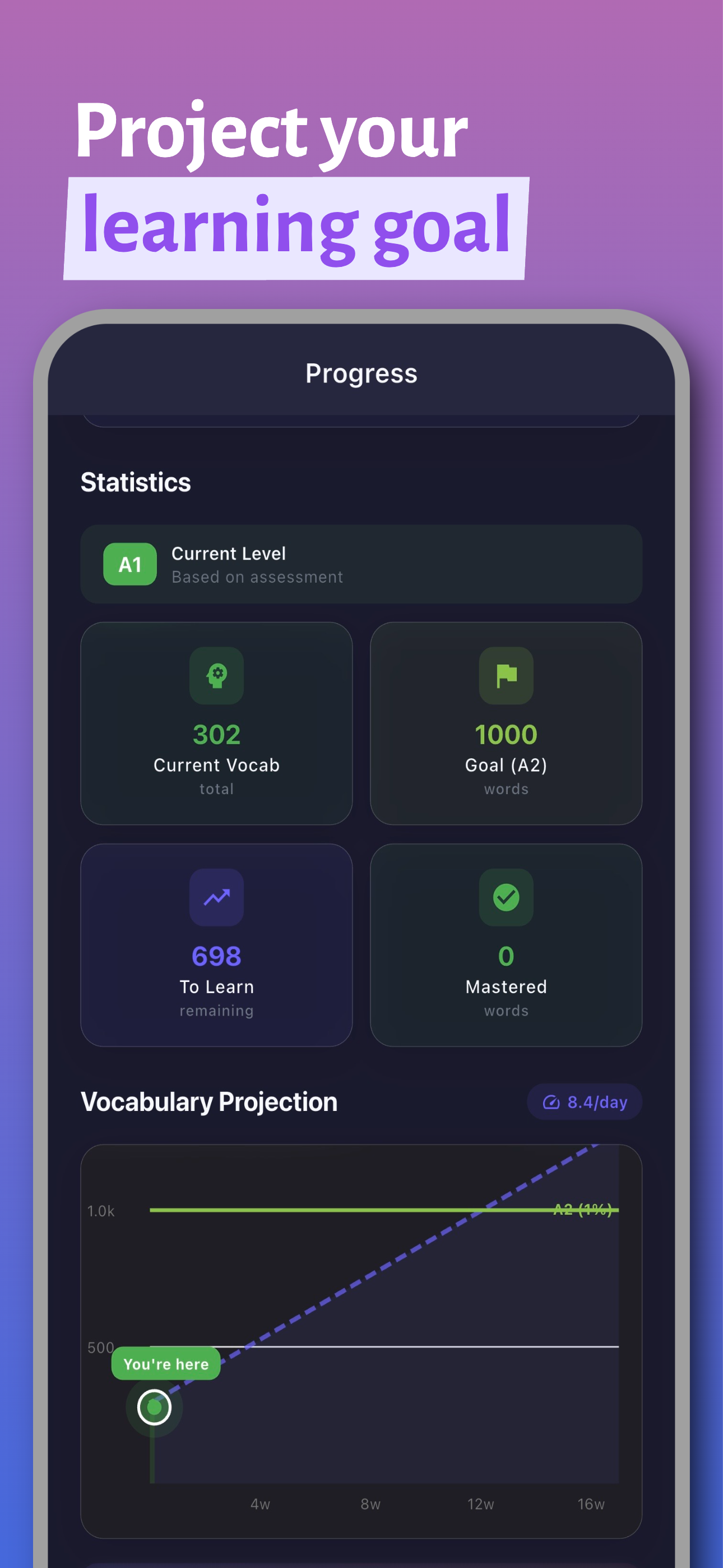
VocaSwipe teaches high-frequency Spanish words first and projects when you will reach each fluency level. See your daily progress in real time.
The 5 Vocabulary Milestones: From Survival to Native-Like
Not every learner has the same goal. Some want to survive a vacation. Others want to read Gabriel García Márquez in the original Spanish. Here is what each vocabulary level actually looks and feels like in practice.
250 Words: Survival Spanish
With 250 words you can handle the absolute basics. You know numbers, greetings, common food items, directions, and essential verbs like ser, tener, querer, and ir. You can order at a restaurant, ask where the bathroom is, and negotiate a taxi fare, though you will sound very much like a beginner.
This is where most travelers operate: enough vocabulary to get by, not enough to have a real conversation. You will lean heavily on gestures, context clues, and the patience of native speakers. The good news is that 250 words is reachable in two to three weeks of focused daily practice.
1,000 Words: Basic Communication
At 1,000 words, something remarkable happens. You cross from “memorizing phrases” into “actually communicating.” You can describe your day, talk about your family, explain what you do for work, and handle most routine interactions without a phrasebook.
Research shows this is the threshold where learners start to think in the language rather than mentally translating from English. You still miss a lot of what native speakers say, especially when they talk fast or use slang. But you are no longer lost. This level aligns roughly with CEFR level A2, which the Council of Europe describes as being able to “communicate in simple and routine tasks.”
2,500 Words: Conversational Fluency
This is the milestone most learners are really after. At 2,500 words, you can hold extended conversations on everyday topics, follow most TV shows and podcasts designed for general audiences, read news articles with occasional dictionary lookups, and express your opinions on familiar subjects.
You will still stumble over specialized vocabulary and complex grammatical structures. But the critical shift is that you can sustain a conversation. You can ask for clarification when you do not understand, paraphrase when you are missing a specific word, and generally keep the interaction flowing. Most people would describe you as “conversationally fluent” at this level.
5,000 Words: Fluent
At 5,000 words, you can function in Spanish without significant limitations. You understand 95% of everyday language, which means you rarely encounter unfamiliar words in normal conversation. You can read novels, follow movies without subtitles, discuss abstract topics like politics or philosophy, and express nuanced opinions.
This is the level that most language schools and immersion programs aim for. It corresponds to CEFR B2-C1, which the framework describes as being able to “interact with a degree of fluency and spontaneity that makes regular interaction with native speakers quite possible without strain for either party.”
10,000+ Words: Native-Like Proficiency
Above 10,000 words, you are operating at a near-native level. You understand jokes, wordplay, regional expressions, and academic or professional vocabulary in your areas of expertise. You can read literary fiction, follow rapid informal speech among groups of native speakers, and express yourself with precision and style.
For context, educated native Spanish speakers typically have an active vocabulary of 20,000-35,000 words and a passive vocabulary (words they recognize but do not regularly use) of 50,000 or more. You do not need to match this as a second-language speaker. Even 10,000-12,000 words will make you functionally indistinguishable from a native speaker in most everyday situations.
Active vs Passive Vocabulary: Why the Difference Matters
There is an important distinction that vocabulary counts alone do not capture: the difference between active and passive vocabulary.
Active vocabulary consists of words you can produce on demand. When you are speaking or writing, these are the words that come to mind naturally. Passive vocabulary includes words you recognize when you hear or read them but cannot reliably produce yourself.
Your passive vocabulary will always be larger than your active vocabulary, typically by a factor of two to three. So if you “know” 2,000 words in the sense that you recognize them, your active vocabulary might only be 800-1,200 words. This is perfectly normal and actually mirrors how native speakers use their own language.
The implication for studying is that you need both types of practice. Flashcard review and daily vocabulary sessions build recognition (passive vocabulary). Active production requires speaking practice, writing exercises, and topic-based drills where you are forced to recall words without prompts.
Daily Word Targets: How Fast Can You Get There?
Knowing the milestones is helpful. Knowing how long each one takes is even better. Here is a realistic projection based on different daily learning rates, assuming you use an effective method like spaced repetition (not just reading word lists):
| Daily Rate | 1,000 Words | 2,500 Words | 5,000 Words |
|---|---|---|---|
| 5 words/day | ~7 months | ~17 months | ~33 months |
| 10 words/day | ~3.5 months | ~8 months | ~17 months |
| 15 words/day | ~2.5 months | ~6 months | ~11 months |
| 20 words/day | ~2 months | ~4 months | ~8 months |
These timelines include the inevitable days you miss and the slight dropout rate where a small percentage of words do not stick on the first cycle. They assume roughly 85-90% retention with a spaced repetition system, which is typical for consistent users.
The Sweet Spot: For most learners, 10-15 new words per day combined with spaced repetition review is sustainable long-term without burning out. At this rate, you reach conversational fluency (2,500 words) in about 6-8 months and solid fluency (5,000 words) in roughly a year.
The critical factor is not the daily number. It is consistency. Learning 15 words every single day for six months will take you further than learning 40 words a day for three weeks and then quitting. This is why building a daily vocabulary habit matters so much.
Why Frequency Word Lists Matter
If you have ever opened a Spanish textbook and found yourself learning words like mariposa (butterfly) and paraguas (umbrella) in the first chapter, you have experienced the problem with non-frequency-based curricula. These are perfectly fine words, but they are not in the top 1,000 most common Spanish words. You will encounter them rarely in daily life.
Frequency-based learning flips this approach. Instead of following a textbook's arbitrary ordering, you learn words in order of how often they actually appear in real Spanish. The word poder (to be able to, can) appears roughly 20 times more often than mariposa in everyday speech. Learning poder first is not just slightly better. It is dramatically more useful.
Several researchers have compiled frequency lists for Spanish based on large corpora of real-world text and speech. The most widely referenced is Mark Davies' A Frequency Dictionary of Spanish, which ranks the 5,000 most common Spanish words based on a 20-million-word corpus spanning spoken language, fiction, newspapers, and academic text.
Apps like VocaSwipe use frequency data to automatically prioritize which words you learn first. Instead of deciding on your own which words are most important, the algorithm ensures you are always working on the highest-value vocabulary for your current level.
Follow @vocaswipe on TikTok
Daily Spanish words, pronunciation tips, and vocabulary challenges.
See how fast you can reach fluency
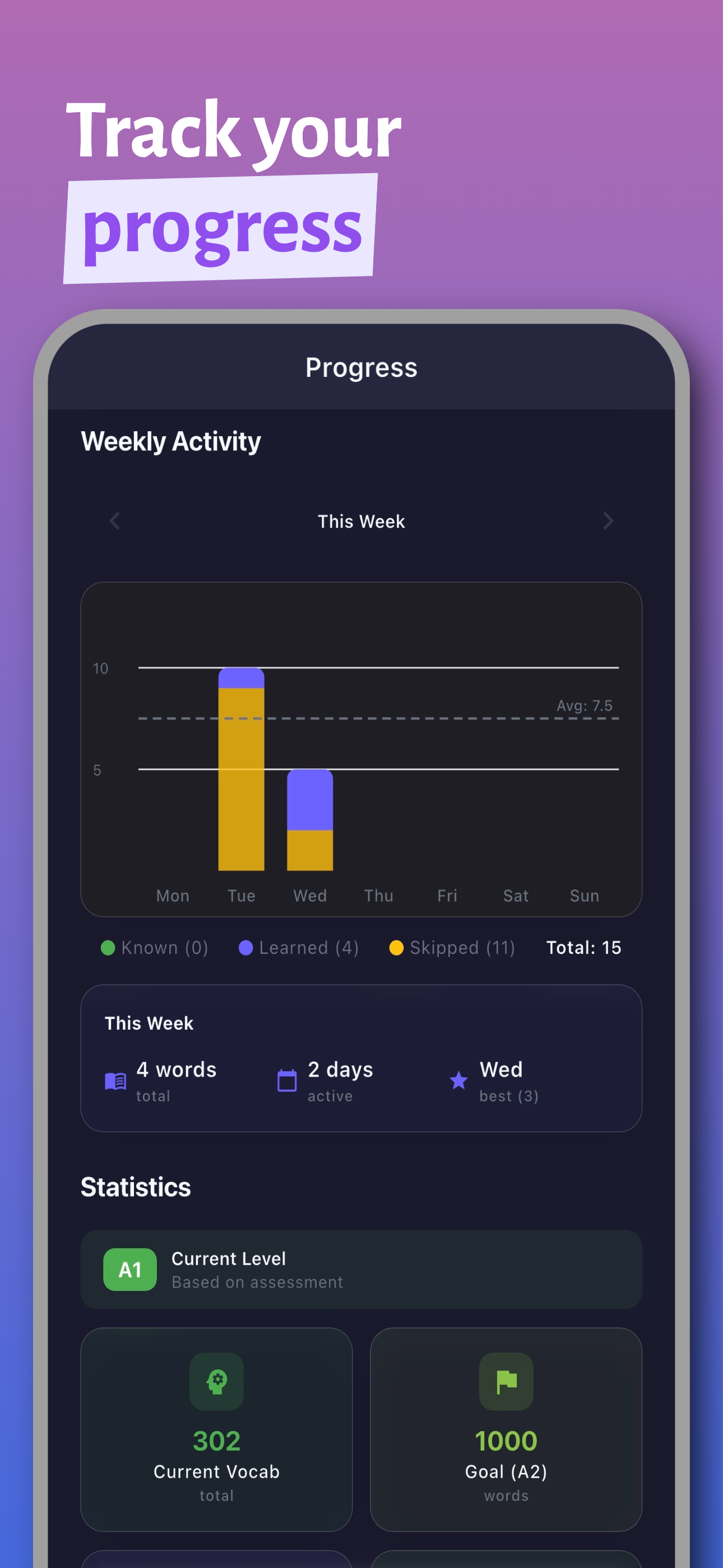
VocaSwipe projects your vocabulary growth and shows you exactly when you will hit each milestone. Start with the highest-frequency words and track every step.
Key Takeaways
- You do not need tens of thousands of words. Just 2,000-2,500 high-frequency words cover roughly 90% of everyday Spanish conversation.
- Frequency matters more than quantity. The 1,000 most common words cover 85% of spoken Spanish. Learn these first.
- 5 milestones define your journey: 250 (survival), 1,000 (basic), 2,500 (conversational), 5,000 (fluent), 10,000+ (native-like).
- Active and passive vocabulary differ. You will always recognize more words than you can produce. Both matter.
- 10-15 new words per day is the sweet spot. At this rate, conversational fluency is roughly 6-8 months away.
- Consistency beats intensity. Daily practice with spaced repetition will outperform any cramming approach.
Frequently Asked Questions
Can you be fluent with 1,000 Spanish words?
Not truly fluent, but 1,000 well-chosen Spanish words will get you surprisingly far. Research shows that the 1,000 most frequent Spanish words cover approximately 85% of everyday spoken language. You will be able to handle basic conversations, understand the gist of most situations, and navigate daily life in a Spanish-speaking country. However, true fluency, where you can discuss abstract topics, understand humor, and express nuanced opinions, typically requires 4,000-5,000 words. Think of 1,000 words as strong functional ability, not fluency.
How many new Spanish words should I learn per day?
For most learners, 10-20 new words per day is the sweet spot. At 15 words per day with consistent practice, you would learn roughly 5,400 words in a year, enough for solid fluency. Beginners should start with 5-10 words daily to build the habit without burning out, then gradually increase. The key is pairing new words with spaced repetition review of older words. Learning 15 new words while reviewing 40-60 previously learned words takes about 10-15 minutes total per day.
What percentage of Spanish is covered by the most common words?
Spanish follows a predictable frequency distribution. The 100 most common words cover about 50% of all spoken Spanish. The top 1,000 words cover roughly 85%. The top 2,000 words cover approximately 90%. And the top 5,000 words cover around 95% of everyday language. This means that learning high-frequency words first gives you dramatically more comprehension per word learned than studying rare vocabulary. It is the single most efficient strategy for building real-world Spanish ability.