You have tried the two-hour Saturday study session. You have downloaded the giant textbook. You have told yourself that this time, you will finally commit to learning Spanish for real. And then life happened. The weekend session got skipped, the textbook gathered dust, and three weeks later you were back to square one.
Here is the uncomfortable truth that most language courses do not want to tell you: the length of your study sessions matters far less than whether you actually do them. A growing body of research in cognitive science and habit formation shows that five focused minutes every single day will get you further than an hour once a week, even though the weekly total is less.
This is not motivational fluff. It is how human memory works. And once you understand the science, building a daily language routine becomes almost embarrassingly simple.
The Science Behind Micro-Learning
Micro-learning is the practice of breaking study material into very small chunks and engaging with them in short, focused bursts. The concept has been gaining traction in corporate training and education for years, but it is especially powerful for vocabulary acquisition.
A 2019 study published in the Journal of Applied Research in Memory and Cognition found that learners who studied vocabulary in multiple short sessions retained significantly more words than those who studied the same material in a single longer session of equal total time. The short-session group showed 23% higher retention at the one-month mark.
Why does this happen? Three mechanisms are at work:
- Spaced encoding: Each short session creates a separate memory trace. Multiple traces formed on different days produce stronger, more durable memories than a single deep encoding session. This is directly related to how spaced repetition works at the neural level.
- Sleep consolidation: Your brain processes and strengthens new memories during sleep. One session gives your brain one night to consolidate. Seven sessions across a week give it seven consolidation cycles. More cycles means deeper encoding.
- Reduced cognitive fatigue: After about 20 minutes of focused study, attention and encoding quality decline sharply. A 5-minute session keeps you in the peak performance zone the entire time. You never hit the point where you are staring at flashcards but nothing is sticking.
The research aligns with findings from the forgetting curve, first described by Hermann Ebbinghaus in the 1880s and confirmed repeatedly since. Without review, you forget roughly 70% of new information within 24 hours. But each well-timed review flattens the curve, and daily micro-sessions provide the ideal review cadence.
Built for your 5-minute routine
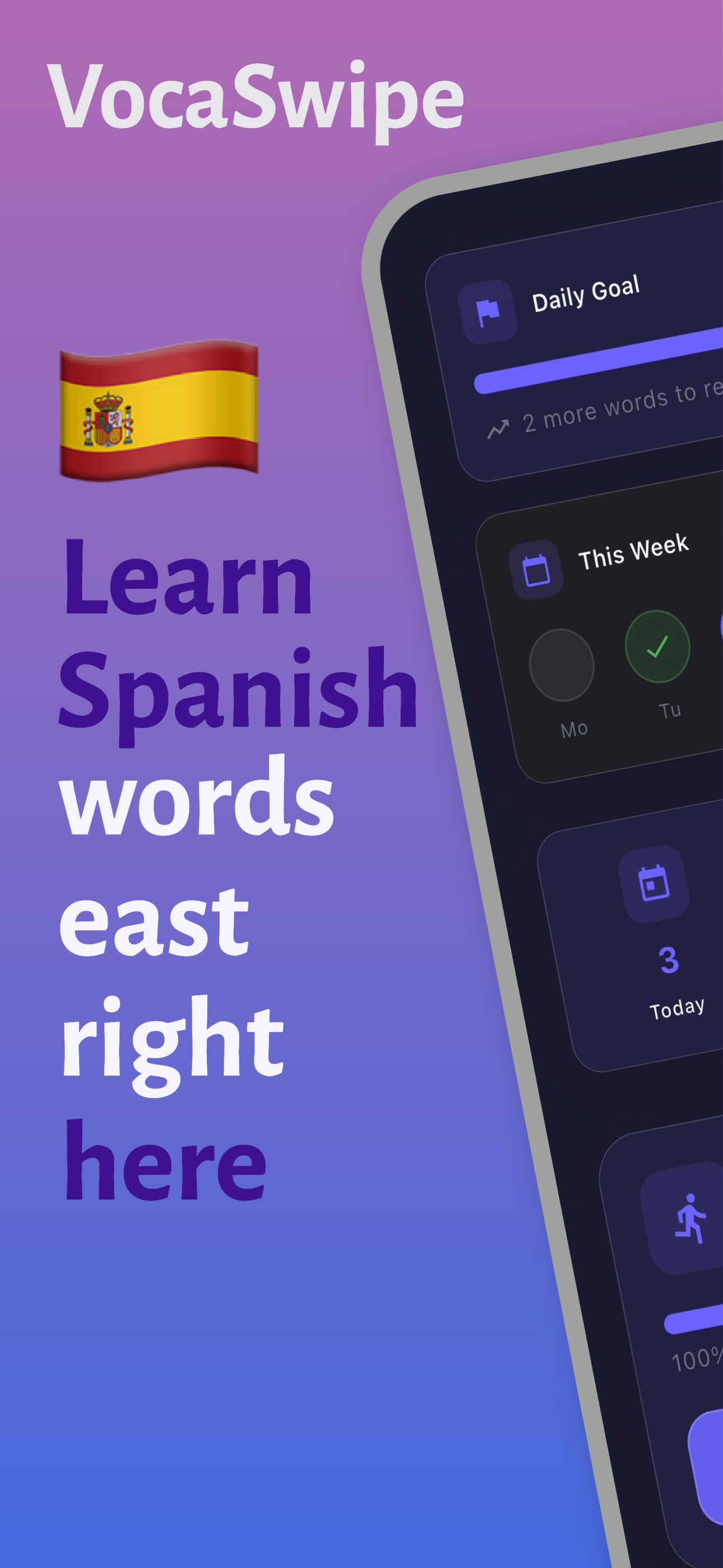
VocaSwipe sessions are designed to fit into 5 minutes or less. AI-powered spaced repetition makes every second count.
Habit Stacking: The Secret to Never Missing a Day
Knowing that short daily sessions work is one thing. Actually doing them every day is another. This is where most people fail, and it is where habit stacking changes the game.
Habit stacking is a technique popularized by behavioral researcher BJ Fogg and author James Clear. The idea is deceptively simple: instead of trying to create a brand-new habit from scratch, you attach the new behavior to something you already do every single day without thinking.
The formula is: After I [existing habit], I will [new habit].
For language learning, this might look like:
- After I pour my morning coffee, I will open my flashcard app and review for 5 minutes.
- After I sit down on my commute, I will do one vocabulary session.
- After I brush my teeth at night, I will review 10 words before bed.
The key is choosing an anchor habit that is rock solid. You are not relying on motivation or willpower. You are simply tagging a small action onto something that already happens automatically. A 2021 study in the British Journal of Health Psychology found that habit stacking increased the consistency of new health behaviors by 40% compared to intention-based approaches.
After about two to three weeks of consistent stacking, the vocabulary session itself starts to feel automatic. You do not decide to practice. You just do it, the same way you do not decide to brush your teeth.
Why 5 Minutes Is the Sweet Spot
You might be wondering: why 5 minutes specifically? Why not 3, or 10, or 15? The answer comes from a combination of research on attention, memory encoding, and habit sustainability.
Short enough to never skip. The biggest enemy of language learning is not difficulty. It is inconsistency. A 30-minute daily commitment sounds reasonable in theory but gets skipped the moment your schedule gets tight. Five minutes is short enough that you can do it while waiting for your coffee to brew, during a bathroom break, or in the elevator. There is never a legitimate reason to skip.
Long enough to be productive. In 5 focused minutes with a spaced repetition system, you can review approximately 20-30 words you have seen before and introduce 5-8 new ones. That is not trivial. Over a month, that is 150-240 new words, plus constant reinforcement of your existing vocabulary.
Aligned with attention research. Studies on focused attention show that the brain's encoding quality is highest in the first few minutes of a task, before the mind begins to wander. A 5-minute session captures almost entirely peak-focus time. You finish before fatigue sets in, which means every minute spent is high-quality learning.
The Math: 5 minutes per day, learning 8 new words daily, means roughly 240 new words per month. At that pace, you reach A1 level (500 words) in about 2 months, A2 (1,000 words) in 4 months, and conversational B1 (2,000 words) in about 8 months. All from a habit that takes less time than scrolling through social media.
The Concrete Morning Routine Template
Here is the exact routine. No ambiguity, no decisions to make. Decisions are the enemy of habits, so every step is predefined.
Step 1: Wake Up and Start Your Morning (0 minutes)
Do whatever you normally do first: use the bathroom, start your coffee, check the time. This is your existing anchor habit. Do not change it.
Step 2: Open Your Flashcard App (30 seconds)
While your coffee brews or while you eat breakfast, open your vocabulary app. If it helps, put the app on your phone's home screen so it is the first thing you see. Remove friction completely.
Step 3: Review Due Words (2-3 minutes)
Start with the words your spaced repetition system has scheduled for review. These are words you have already learned but need to reinforce. Go through them at a comfortable pace. Do not rush. The goal is genuine recall, not speed.
Step 4: Learn New Words (2-3 minutes)
After reviews, introduce new vocabulary. Focus on a single category or topic to create natural memory clusters. If you are learning food vocabulary, keep all your new words in that domain. The semantic connections between related words help each one stick.
Step 5: Close the App and Continue Your Day (0 minutes)
That is it. No journaling, no grammar drills, no guilt about not doing more. Five minutes, done. Your brain will continue processing those words in the background throughout the day, and sleep will cement them further overnight.
Weekly and Monthly Progression
The daily micro-session is the engine. But you also need a lightweight weekly check-in to stay on track and keep motivation high.
Weekly Check-in (5 minutes, once a week)
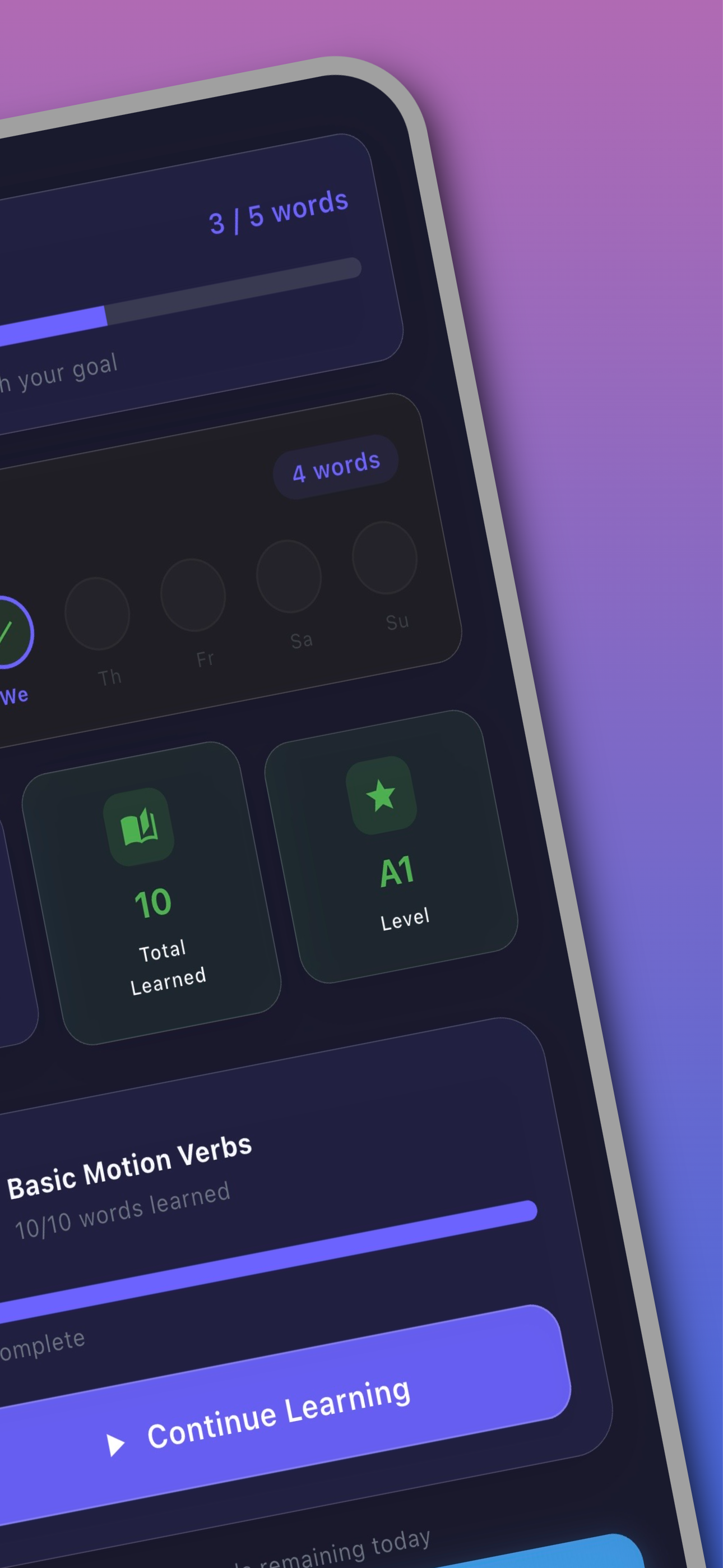
Pick one day, perhaps Sunday evening, to glance at your stats. Most vocabulary apps track your total words learned, retention rate, and daily streak. These numbers serve two purposes: they show you that your small daily effort is actually accumulating into something significant, and they help you spot problems early. If your retention rate drops below 80%, you might be adding too many new words too quickly.
Monthly Milestone
At the end of each month, note your total word count. Compare it to the CEFR vocabulary benchmarks: 500 for A1, 1,000 for A2, 2,000 for B1. Watching yourself progress through these levels, month by month, creates a powerful feedback loop. You are not just doing flashcards. You are measurably advancing toward fluency.
If you are comfortable with your pace, consider gradually extending your daily session from 5 minutes to 7 or 10. But never increase at the expense of consistency. A 5-minute session you do every day beats a 15-minute session you do three times a week.
Why Consistency Beats Intensity Every Time
There is a persistent myth in language learning that more hours equals faster results. Immersion programs, 8-hour study days, weekend boot camps. These have their place, but for vocabulary acquisition specifically, the research is clear: frequency of exposure matters more than duration of exposure.
A study by Cepeda et al. published in Psychological Science examined the optimal spacing of study sessions and found that distributing practice across many short sessions produced substantially better long-term retention than concentrating the same amount of practice into fewer, longer sessions. The effect was especially pronounced for material that needed to be retained over weeks or months, which is exactly the case for vocabulary learning.
Think about it this way: if you study for one hour on Saturday, you get one encoding event and one night of sleep consolidation before the next session. If you study for 8 minutes each day (roughly the same total time), you get seven encoding events and seven nights of consolidation. The distributed approach gives your brain seven times more opportunities to strengthen those word memories.
This is also why learning Spanish does not have to feel overwhelming. You do not need to carve out large blocks of time. You just need to show up for a few minutes, every single day, without exception.
Follow @vocaswipe on TikTok
Daily Spanish words, quick tips, and 60-second vocabulary challenges.
Designed for the 5-Minute Window
Not every vocabulary app is built for micro-sessions. Many are designed around 15-20 minute lessons that are hard to compress. VocaSwipe was built specifically with the 5-minute window in mind. The swipe-based interface lets you move through flashcards quickly, the AI-powered spaced repetition algorithm prioritizes the words you need most, and the session tracker shows you exactly how much progress you are making in those daily minutes.
The streak feature is also designed around daily consistency. Missing a day breaks the streak, which creates just enough psychological nudge to keep you opening the app. It is a small thing, but habit research consistently shows that streak tracking is one of the most effective tools for building and maintaining daily behaviors.
Start your 5-minute habit today
VocaSwipe makes daily vocabulary practice effortless. Track your streak, watch your word count grow, and reach your Spanish goals one session at a time.
Key Takeaways
- Short daily sessions beat long weekly ones. Research shows 23% higher retention from distributed micro-sessions compared to massed study of equal total time.
- Habit stacking makes consistency automatic. Attach your vocabulary session to something you already do every day, like morning coffee.
- 5 minutes is the sweet spot. Short enough to never skip, long enough to learn 5-8 new words and review 20-30 existing ones.
- 7 sleep cycles beat 1. Daily sessions give your brain seven nights of memory consolidation per week instead of one.
- Track weekly, celebrate monthly. A quick stats check keeps you motivated and helps you catch problems early.
- The routine: coffee, flashcards, done. No decisions, no friction, no excuses. Just 5 minutes and move on.
Frequently Asked Questions
Can you really learn a language in 5 minutes a day?
You will not become fluent in 5 minutes a day alone, but you can make meaningful, consistent progress. Research shows that short daily sessions of focused vocabulary practice using spaced repetition can help you learn 10-15 new words per day. That adds up to 300-450 words per month, which means you could reach conversational vocabulary levels (around 2,000 words) in under a year. The key is consistency. Five minutes every single day outperforms longer sessions done sporadically.
What is the best time of day to study vocabulary?
Research from cognitive science suggests two optimal windows. Morning sessions, particularly shortly after waking, benefit from a refreshed working memory and strong encoding ability. Evening sessions, done within an hour of sleep, benefit from sleep consolidation. If you can only pick one time, choose morning for new word learning and attach it to an existing habit like your morning coffee. If you can do two short sessions, learn new words in the morning and review in the evening.
How many words can you learn in a 5-minute session?
In a focused 5-minute session using flashcards with spaced repetition, most learners can review 20-30 previously learned words and introduce 5-8 new words. The exact number depends on your current level and the difficulty of the words. Beginners working with common, concrete nouns will move faster than advanced learners tackling abstract vocabulary. The important thing is not to maximize the count but to ensure genuine recall.