Starting a new language from absolute zero is simultaneously exciting and overwhelming. There are thousands of words to learn, grammar rules to internalize, pronunciation patterns to master, and an entire culture to begin understanding. Where do you even begin?
The answer is simpler than most people think. You do not need to learn everything. You need to learn the right things in the right order. Spanish has a structure that rewards strategic learners: a small number of high-frequency words cover a disproportionate share of everyday conversation, and the grammar follows patterns that are far more regular than English.
This roadmap gives you a concrete, week-by-week plan for your first three months. It is based on frequency data (which words and structures appear most often in real Spanish), cognitive science (how your brain most efficiently acquires new information), and the CEFR framework (which defines what you should be able to do at each level). Follow it and you will go from knowing zero Spanish to holding basic conversations.
Start your Spanish journey today
VocaSwipe is built for absolute beginners. Swipe through flashcards, hear native pronunciation, and track your progress from day one.
Month 1: Build the Foundation (Weeks 1-4)
Weeks 1-2: Alphabet, Pronunciation, and Your First 50 Words
Your first task is learning how Spanish sounds. This is not about memorizing grammar rules. It is about training your ears and mouth for a new set of sounds. Spend the first day or two on the Spanish alphabet and basic pronunciation rules. Spanish is highly phonetic, meaning words are pronounced almost exactly as they are spelled. Once you learn the sound each letter makes, you can pronounce any word you see.
Focus on the five vowels (a, e, i, o, u), which never change sound, and the consonants that differ from English: the rolled rr, the ñ, the j, and the soft d between vowels. A detailed breakdown of every sound is available in our Spanish pronunciation guide.
Simultaneously, begin learning your first 50 words. These should be the highest-frequency words in everyday Spanish:
- Greetings: hola, adiós, buenos días, buenas noches, por favor, gracias, de nada, perdón
- Numbers 1-20: uno, dos, tres... through veinte
- Essential nouns: agua, comida, casa, persona, día, tiempo, año, nombre
- Common adjectives: bueno, malo, grande, pequeño, nuevo, viejo
- Question words: qué, cómo, dónde, cuándo, por qué, cuánto
Use spaced repetition flashcards to learn these words. Five to ten minutes per day is enough. The goal by the end of week two is to recognize and pronounce these 50 words without hesitation.
Weeks 3-4: Greetings, Introductions, and Simple Phrases
Now you start combining words into phrases. This is where Spanish begins to feel like a language rather than a word list. Focus on practical phrases you would use in real life:
- Self-introduction: Me llamo... (My name is...), Soy de... (I am from...), Tengo... años (I am... years old)
- Basic questions: ¿Cómo te llamas? (What is your name?), ¿Dónde está...? (Where is...?), ¿Cuánto cuesta? (How much does it cost?)
- Polite expressions: Lo siento (I am sorry), Con permiso (Excuse me), ¿Puede repetir? (Can you repeat?)
- Numbers 20-100 and basic telling of time
Continue adding 5-10 new vocabulary words per day through spaced repetition. By the end of month one, you should know approximately 100-150 words and be able to introduce yourself, ask basic questions, and handle simple social situations.
Month 1 milestone: You should be able to introduce yourself, say where you are from, count to 100, and ask basic questions like “where is the bathroom?” and “how much does this cost?”
Month 2: Core Grammar and 200+ Words (Weeks 5-8)
The Four Essential Verbs: Ser, Estar, Tener, Ir
Month two is when grammar enters the picture, but strategically. Instead of trying to learn every conjugation pattern, focus on four verbs that appear in virtually every Spanish conversation:
- Ser (to be, permanent): Soy estudiante. (I am a student.) Es grande. (It is big.)
- Estar (to be, temporary/location): Estoy bien. (I am fine.) Está en la mesa. (It is on the table.)
- Tener (to have): Tengo hambre. (I am hungry, lit. “I have hunger.”) Tiene dos hijos. (She has two children.)
- Ir (to go): Voy al supermercado. (I am going to the supermarket.) ¿Adónde vas? (Where are you going?)
Learn the present tense conjugations for all four. These four verbs alone will carry you through an enormous range of conversations. The ser/estar distinction (both mean “to be” but are used in different contexts) is the first grammar concept that feels genuinely foreign to English speakers. Give it time. The distinction becomes intuitive with practice.
Expanding Vocabulary to 200+ Words
Continue your daily flashcard practice, targeting 10-15 new words per day. Organize your vocabulary by practical categories:
- Food and drink: desayuno, almuerzo, cena, carne, pollo, arroz, pan, leche, café, cerveza
- Places: restaurante, hotel, aeropuerto, tienda, hospital, escuela, parque, playa
- Daily routines: despertar, comer, trabajar, dormir, cocinar, limpiar, comprar
- Descriptions: bonito, feo, caro, barato, rápido, lento, fácil, difícil
- Family: madre, padre, hermano, hermana, hijo, hija, abuelo, abuela
By the end of month two, you should know approximately 200-300 words, be comfortable with present-tense conjugation of the four essential verbs, and be able to form simple sentences about your daily life, preferences, and plans.
Common Beginner Mistakes to Avoid
- Translating word-for-word from English: Spanish has different sentence structures. “I like the house” becomes “Me gusta la casa” (literally, “The house pleases me”). Accept that some constructions will feel backward at first.
- Ignoring gender: Every Spanish noun is masculine or feminine. “El libro” (the book, masculine) and “la mesa” (the table, feminine). Learn the article with every noun from the start. It is much harder to fix later.
- Studying grammar without vocabulary: Grammar rules are useless if you do not have enough words to apply them. Always prioritize vocabulary building alongside grammar study.
- Avoiding speaking: Reading and listening are important, but speaking activates different brain pathways. Start speaking from day one, even if it is just reading flashcards aloud.
Month 3: Sentences, Past Tense, and First Conversations (Weeks 9-12)
Reaching 500 Words
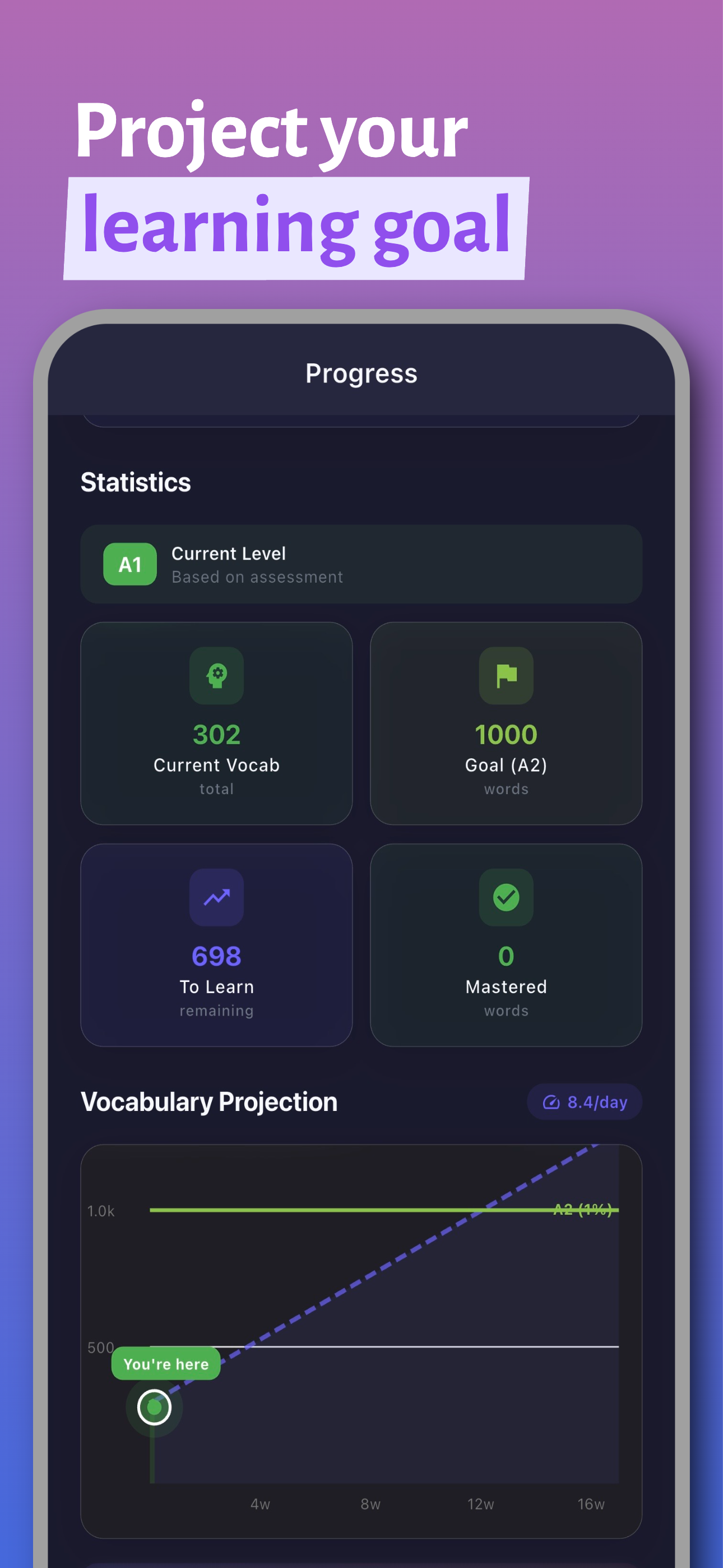
By month three, your daily flashcard habit should feel automatic. You are reviewing older words (which takes less and less time as spaced repetition intervals lengthen) and adding new ones. Push toward the 500-word mark, which corresponds to CEFR A1 level, the point where basic communication becomes genuinely possible.
Focus your new vocabulary on areas relevant to your life: your job, your hobbies, topics you actually want to talk about. Generic word lists have diminishing returns after the first 200 high-frequency words. Now you need vocabulary that connects to your real-world conversations.
Introduction to Past Tense
Once you are comfortable with present tense, begin learning the pretérito indefinido (simple past) for the four essential verbs and a handful of common regular verbs. This unlocks the ability to talk about what happened yesterday, last week, or on your last vacation, a massive expansion of what you can communicate.
- Fui (I went), fue (it was, from ser/ir)
- Tuve (I had), estuve (I was, from estar)
- Hablé (I spoke), comí (I ate), viví (I lived)
Do not try to master every past tense form. Focus on the first person (yo) and third person (el/ella) forms of verbs you actually use. You can expand to other forms later. The goal right now is communication, not grammatical perfection.
Having Your First Real Conversations
By week 10-12, you should actively seek out conversation practice. Language exchange apps, Spanish-speaking friends, local conversation groups, or even talking to yourself in Spanish while doing chores. Your first conversations will be halting, error-filled, and uncomfortable. That is completely normal.
Here is what you should be able to do by the end of month three:
- Introduce yourself and ask about others
- Talk about your daily routine, job, and family
- Order food at a restaurant and handle basic shopping
- Ask for and understand simple directions
- Describe past events in basic terms
- Understand slow, clear spoken Spanish on familiar topics
Month 3 milestone: 500+ words, present and basic past tense, able to have a simple 3-5 minute conversation on familiar topics. This is CEFR A1, the internationally recognized “breakthrough” level.
Follow @vocaswipe on TikTok
Beginner-friendly Spanish lessons, daily vocabulary, and quick grammar tips.
Your Beginner Resources Checklist
You do not need dozens of resources. In fact, too many resources is a common beginner trap. Here is the minimum effective toolkit:
- Vocabulary app with spaced repetition: VocaSwipe or similar. This is your daily non-negotiable, 5-10 minutes per day for building and retaining vocabulary.
- A beginner podcast: Look for podcasts designed for A1 learners that use slow, clear Spanish with English explanations. Listen during commutes or while doing chores.
- A basic grammar reference: A single textbook or website you can check when you encounter a new grammar concept. Do not read it cover to cover. Use it as a reference.
- Conversation practice: A language exchange partner, a tutor (even once a week), or a conversation group. This can wait until month two or three, but do not skip it entirely.
- A notebook or digital doc: Write down phrases you find useful, mistakes you keep making, and words you want to learn. The act of writing reinforces memory.
That is five tools. Resist the urge to add more until you have used these consistently for at least a month. Jumping between apps and resources feels productive but often just fragments your motivation and attention.
Your first 500 Spanish words start here
VocaSwipe organizes vocabulary by category and CEFR level, uses spaced repetition for maximum retention, and tracks every word you learn. Built for beginners.
Key Takeaways
- Start with pronunciation, not grammar. Learning how Spanish sounds first ensures every word you learn is correctly stored in memory.
- 50 words in two weeks, 500 in three months. These are achievable targets with just 10 minutes of daily flashcard practice.
- Four verbs carry most conversations. Ser, estar, tener, and ir cover an enormous range of what you need to say at the beginner level.
- Learn the article with every noun. “La mesa” not just “mesa.” Fixing gender associations later is much harder than learning them right.
- Speak from day one. Even reading flashcards aloud counts. Do not wait until you feel “ready.”
- Five resources maximum. Focus beats variety at the beginner stage. Master a few tools before adding more.
Frequently Asked Questions
Can I learn Spanish on my own?
Absolutely. Millions of people have reached conversational fluency in Spanish through self-study. The keys are consistency (daily practice, even if only 5-10 minutes), using evidence-based methods like spaced repetition and active recall rather than passive review, and eventually adding conversation practice with native speakers. A structured classroom is helpful but not required. The most important factor is showing up every day.
What should I learn first in Spanish?
Start with pronunciation and the Spanish alphabet, which takes only a day or two and ensures you can correctly say every word you learn afterward. Next, learn 30-50 high-frequency words: greetings, numbers 1-20, and essential nouns. Then move to basic phrases for self-introduction and simple questions. After the first two weeks, begin learning basic verb conjugations starting with ser, estar, tener, and ir. This sequence builds a foundation that makes everything else easier to learn.
How long until I can have a basic conversation?
With consistent daily practice of 10-15 minutes using effective methods, most learners can hold a basic conversation within 2-3 months. This corresponds to roughly CEFR A1-A2 level and requires knowing approximately 500-1,000 words plus basic present-tense verb conjugations. The timeline shortens significantly if you add conversation practice with native speakers, as speaking activates different memory pathways than passive study alone.