Five years ago, AI in language learning meant basic chatbots that could barely hold a coherent conversation and speech recognition that misunderstood every third word. In 2026, the landscape is unrecognizable. AI now powers adaptive difficulty systems, predicts exactly when you are about to forget a word, generates personalized learning content, and provides pronunciation feedback that rivals a patient human tutor.
The global language learning market is projected to exceed $115 billion by 2028, and AI-powered tools are driving much of that growth. But not all AI applications in language learning are equally valuable. Some are genuinely transformative. Others are marketing buzzwords wrapped around basic features.
This article separates the real innovations from the hype, examines what is actually working in 2026, and looks at what is coming next. Whether you are choosing a learning tool or just curious about the technology, this is a clear-eyed look at where AI stands in language education today.
Experience AI-powered vocabulary learning
VocaSwipe uses AI spaced repetition to schedule your reviews at the scientifically optimal moment. Learn Spanish vocabulary smarter, not harder.
5 AI Innovations That Are Actually Working
Not every AI feature in a language app is meaningful. These five innovations have measurable evidence of effectiveness and represent genuine advances over pre-AI methods.
1. Adaptive Difficulty Systems
Traditional language courses follow a fixed curriculum: Lesson 1, then Lesson 2, then Lesson 3, regardless of whether you mastered Lesson 1 or struggled through it. AI-powered adaptive systems monitor your performance in real time and adjust the difficulty continuously.
If you are breezing through food vocabulary but struggling with verb conjugations, the system allocates more practice time to verbs without making you repeat food words you already know. This is not a minor convenience. Research on the zone of proximal development, a concept from educational psychology, shows that learning is most effective when material is slightly above your current ability level. Too easy and you disengage. Too hard and you become frustrated and quit.
AI keeps you in that optimal zone automatically, something a human teacher can approximate but cannot do with the same precision across thousands of individual data points.
2. Personalized Learning Paths
Your ideal learning path depends on your native language, your goals, your available time, and your existing knowledge. A Portuguese speaker learning Spanish needs a very different curriculum than a Korean speaker. Someone learning Spanish for travel has different vocabulary priorities than someone learning for business.
AI systems in 2026 build individualized curricula based on these factors. They analyze your performance patterns to identify which categories of words you find easy (often cognates from your native language) and which require more reinforcement. They prioritize vocabulary that aligns with your stated goals and adjust the sequence based on what you have already demonstrated you know.
The result is a learning experience where almost every minute of study time is spent on material that actually moves you forward, rather than reviewing things you already know or learning words that do not match your goals.
3. Smart Spaced Repetition
Spaced repetition itself is not new. The Leitner system dates back to the 1970s, and digital SRS tools like Anki have been around for decades. What AI adds is predictive accuracy and personalization that older algorithms cannot match.
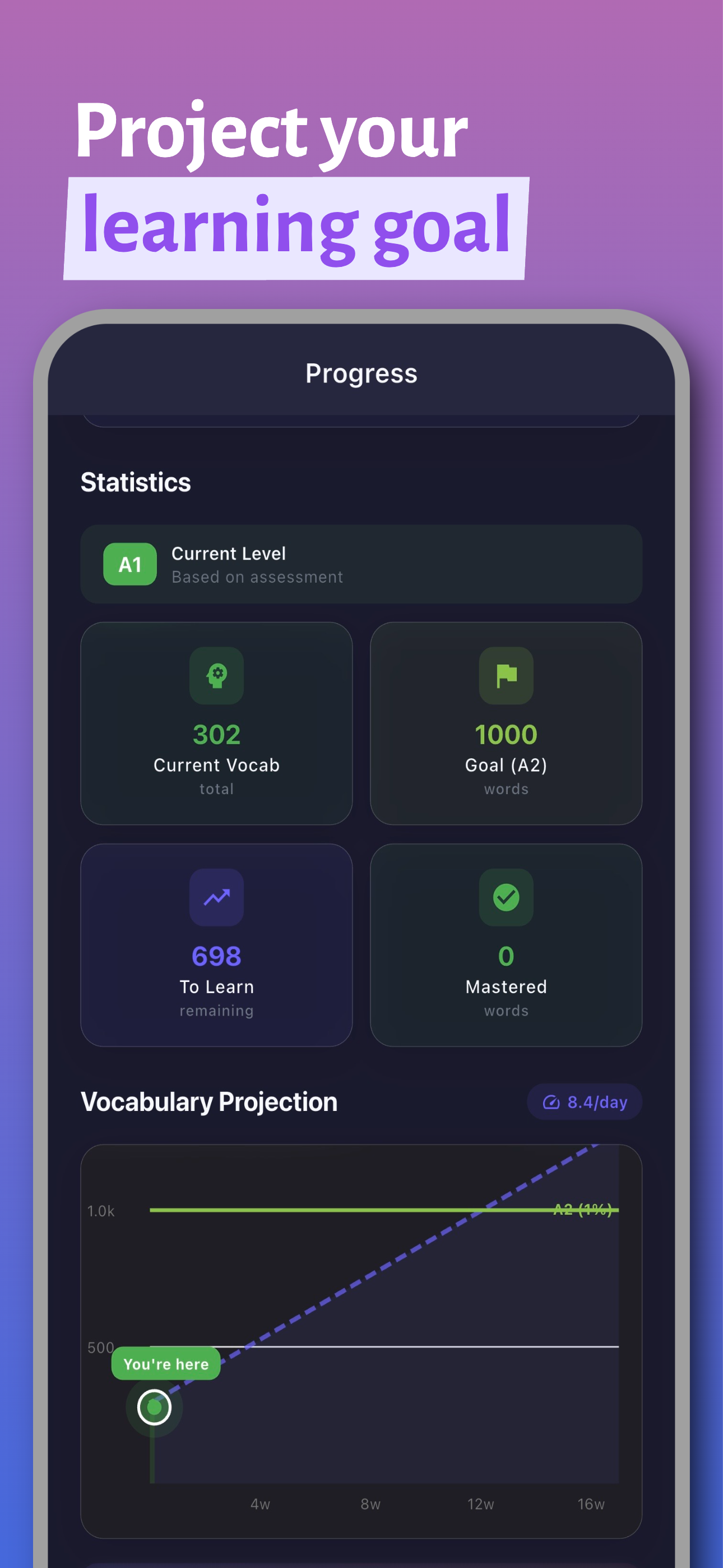
Traditional SRS uses fixed interval multipliers. If you get a word right, the interval doubles. If you get it wrong, it resets. AI-based SRS analyzes patterns across your entire learning history: time of day you study, how long you take to answer, which word categories you find difficult, even whether you tend to forget more on Mondays after weekends. It uses these patterns to predict the optimal review moment for each individual word with much greater precision.
The practical impact is significant. Users of AI-powered SRS systems report spending less time on reviews while maintaining higher retention rates. You study fewer cards per session because the algorithm is better at predicting which ones you actually need to see.
4. NLP-Powered Pronunciation Feedback
Natural language processing has reached a point where apps can provide useful pronunciation feedback in real time. Modern systems do not just tell you whether a word was pronounced correctly or incorrectly. They identify specific phonemes you are struggling with, compare your intonation patterns to native speakers, and provide targeted exercises for your particular pronunciation challenges.
For Spanish learners, this is especially valuable for sounds that do not exist in English: the rolled R, the soft D between vowels, and the distinction between B and V (which are essentially the same sound in Spanish). AI systems can detect these specific errors and drill the exact phonemes you need to practice, rather than making you repeat entire sentences.
This is still not as good as a skilled pronunciation coach, but it is available 24/7, it never gets impatient, and it can provide hundreds of repetitions in a single session, something most tutors would find tedious to deliver.
5. AI-Generated Content and Exercises
One of the most practical AI applications in 2026 is content generation. AI can create reading passages, dialogues, and exercises calibrated to your exact vocabulary level. Instead of searching for graded readers at the right difficulty, the system generates text that uses primarily words you already know plus a controlled number of new words in context.
This is a significant advance for intermediate learners, who often struggle to find content that is challenging enough to be useful but not so difficult that they need a dictionary every other sentence. AI-generated content sits in that sweet spot automatically, adapting as your vocabulary grows.
Market Trends Driving AI Language Learning
Several market forces are accelerating the adoption of AI in language education. Understanding these trends helps explain why the tools available today are so much better than what existed even two years ago.
First, the cost of AI inference has dropped by roughly 90% since 2023. Features that would have been prohibitively expensive to run for millions of free-tier users are now economically viable. This means sophisticated AI features are no longer locked behind premium subscriptions.
Second, mobile-first design has become the default. Over 80% of language learning app usage happens on smartphones, and AI models have been optimized to run efficiently on mobile hardware. This enables real-time features like pronunciation feedback without requiring a constant server connection.
Third, the remote work revolution has created enormous demand for multilingual skills. Professionals who never considered learning a second language are now doing so because their teams span multiple countries. This has expanded the market beyond traditional language enthusiasts and students to include working adults who need practical results quickly.
What Is Coming Next: The Near Future of AI Language Learning
The next wave of AI language learning tools is already in development, and several innovations are likely to reach consumers within the next one to two years.
Conversational AI Partners
AI conversation partners are improving rapidly. Current systems can maintain topical conversations, adjust their vocabulary to your level, and provide corrections. The next generation will add emotional awareness, detecting frustration or confusion from your response patterns and adjusting their approach accordingly. They will also become better at simulating specific scenarios: ordering at a restaurant, negotiating at a market, or handling a job interview.
Emotion-Aware Tutoring
AI systems are beginning to incorporate affective computing, the ability to recognize and respond to learner emotions. When a learner is frustrated (detected through response patterns, hesitation times, and error rates), the system can simplify the material, offer encouragement, or switch to a different activity type. When a learner is bored (rapid correct answers, declining engagement time), it can increase the challenge.
Early research on emotion-aware tutoring systems shows a 25% improvement in learner persistence compared to emotion-blind systems. For language learning, where dropout rates are notoriously high, this could be transformative for long-term motivation.
Augmented Reality Language Overlays
With AR glasses becoming more mainstream, the possibility of real-time language overlays is moving from science fiction to engineering reality. Imagine walking through a Spanish-speaking city and seeing vocabulary labels appear on objects around you, or having subtitle-like translations appear during a conversation with a native speaker.
This is not available for consumers yet, but prototype systems are already being tested in educational research settings. The combination of computer vision (identifying objects), NLP (translating in context), and AR display technology could create immersive language learning experiences that blur the line between study and real-world use.
What AI Still Cannot Replace
For all its advances, AI has clear limitations in language education that are important to acknowledge honestly. Understanding these limits helps you use AI tools more effectively rather than expecting them to do everything.
Genuine human connection. Language exists to connect people. The motivation that comes from wanting to communicate with a specific person, understand a culture, or belong to a community cannot be simulated by an algorithm. Human teachers and conversation partners provide social and emotional dimensions that AI cannot replicate.
Cultural depth. AI can teach you that “tú” and “usted” both mean “you,” and it can explain the formal/informal distinction. But the subtle social instinct for when to switch between them, the regional variations, the generational shifts in usage, these come from human interaction and cultural immersion, not from training data.
Spontaneous conversation. Even the best AI conversation partners in 2026 follow somewhat predictable patterns. Real human conversation is messy, unpredictable, and full of interruptions, topic changes, and implicit meaning. Practicing with AI prepares you for structured exchanges, but the cognitive demands of real conversation are still qualitatively different.
The smartest approach is to use AI for what it does best, vocabulary, review scheduling, personalized practice, and pronunciation drilling, while seeking human interaction for conversation, cultural learning, and the social motivation that keeps you going long-term. As we discussed in our comparison of apps versus classes, the hybrid approach consistently produces the best outcomes.
AI Spaced Repetition in Practice: How VocaSwipe Uses AI
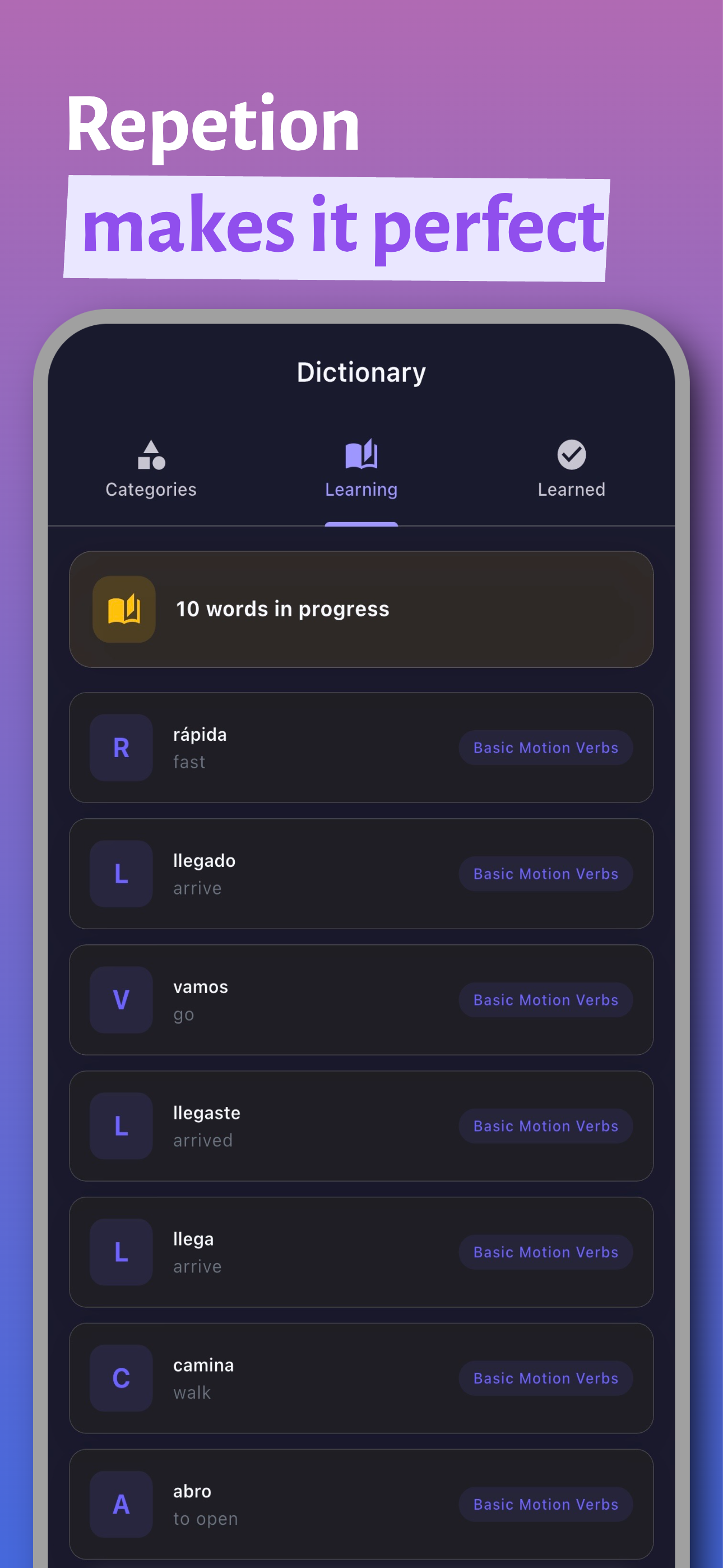
To see how these AI concepts translate to a real product, consider how VocaSwipe applies AI-powered spaced repetition to Spanish vocabulary learning. Rather than using fixed review intervals, the app analyzes your performance patterns across every word you study and predicts the optimal moment for each review.
Words you find easy get scheduled further into the future. Words you struggle with come back sooner. The system also considers factors like word similarity (you might confuse “pero” and “perro”) and schedules reviews of easily confused pairs closer together to strengthen the distinction. The result is that study sessions are shorter and more focused, because you are only reviewing the words that actually need reinforcement.
This is a practical example of AI innovation number three from earlier in this article: smart spaced repetition that goes beyond simple interval multiplication to genuinely personalized memory optimization. It is the kind of AI application that delivers measurable results rather than just impressive-sounding features.
Follow @vocaswipe on TikTok
Daily Spanish words, pronunciation tips, and vocabulary challenges.
Try AI-powered vocabulary learning for free
VocaSwipe brings smart spaced repetition to Spanish vocabulary. Let AI optimize your review schedule while you focus on learning.
Key Takeaways
- AI excels at personalization. Adaptive difficulty, individualized learning paths, and smart SRS deliver measurably better results than one-size-fits-all approaches.
- Smart SRS is the most impactful AI feature. Predicting optimal review timing for each word produces higher retention with less study time.
- Pronunciation feedback has matured. NLP-powered systems now provide useful phoneme-level corrections in real time.
- AI-generated content fills the difficulty gap. Intermediate learners benefit most from text calibrated to their exact vocabulary level.
- AI will not replace human teachers. Conversation, cultural depth, and social motivation remain uniquely human contributions.
- The hybrid future is here. AI handles vocabulary, review scheduling, and personalized practice while humans provide conversation and cultural context.
Frequently Asked Questions
How does AI help with language learning?
AI helps in several concrete ways. Adaptive difficulty systems adjust content to your exact level in real time, keeping you in the optimal learning zone. Smart spaced repetition algorithms predict when you are about to forget each word and schedule reviews at the perfect moment. Personalized learning paths prioritize vocabulary based on your goals and native language. NLP-powered pronunciation feedback identifies specific phonemes you need to practice. The overall effect is a learning experience that adapts to you rather than forcing you through a fixed curriculum.
Will AI replace language teachers?
No. AI will transform the role of language teachers, but not eliminate it. AI handles the repetitive, data-driven aspects of learning exceptionally well: vocabulary drilling, review scheduling, grammar pattern practice, and pronunciation drills. Teachers remain essential for genuine conversation practice, cultural context, emotional support, and the kind of nuanced error correction that requires human understanding. The future is a hybrid model where AI manages individual practice and teachers focus on what humans do best. As we explore in our apps vs classes comparison, the combination outperforms either approach alone.
What makes AI flashcards better than regular ones?
Traditional flashcards show every card at the same frequency regardless of difficulty. AI flashcards track your performance on each individual word and use predictive algorithms to schedule reviews at exactly the right moment. Words you know well get pushed further into the future. Words you struggle with come back sooner. The system also detects patterns like easily confused word pairs and schedules them strategically. Research shows this approach improves long-term retention by over 200% compared to regular flashcard study, while actually reducing total study time.