Learning Spanish is one of the most rewarding investments you can make. It opens doors to 500 million speakers across more than 20 countries, boosts your career prospects, and reshapes how you see the world. But the path from beginner to fluent is littered with avoidable mistakes that slow people down for months or even years.
The frustrating part is that most of these mistakes feel productive while you are making them. You think you are studying hard, doing everything right, and then wonder why progress stalls. The truth is that effort without the right strategy is mostly wasted effort.
After analyzing how thousands of language learners study and where they get stuck, a clear pattern emerges. The same twelve mistakes come up again and again. Fix these, and you will learn faster than you thought possible.
Avoid mistake #2 automatically
VocaSwipe uses AI-powered spaced repetition to schedule your reviews at the perfect moment. No cramming, no forgetting.
1. Obsessing Over Grammar Before Building Vocabulary
This is the single most common mistake, and traditional language education is largely to blame. Textbooks start with conjugation tables, verb tenses, and grammatical gender rules. Meanwhile, the student knows 50 words and cannot understand a single sentence of real Spanish.
Research by Paul Nation at Victoria University of Wellington shows that vocabulary knowledge is the strongest predictor of reading comprehension and communicative ability in a foreign language. You can communicate with 2,000 words and imperfect grammar. You cannot communicate with perfect grammar and 100 words.
The fix: Spend your first 3-6 months focused primarily on vocabulary. Aim for 500-1,000 high-frequency words before dedicating serious time to grammar rules. You will naturally absorb basic patterns through exposure to phrases and sentences.
2. Not Using Spaced Repetition
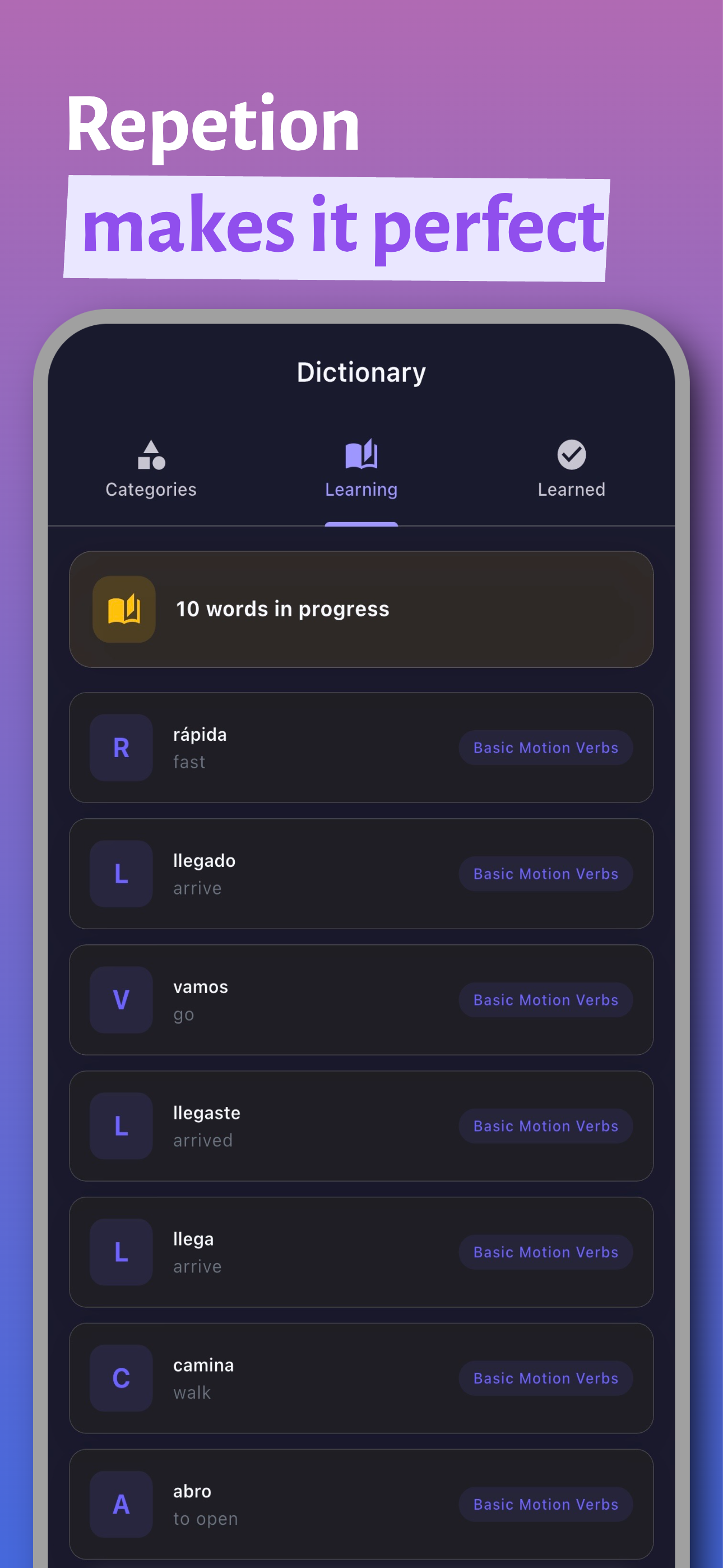
If you are reviewing vocabulary using random word lists, rereading notes, or flipping through the same flashcard deck front-to-back, you are wasting most of your study time. Without spaced repetition, you end up over-reviewing words you already know and under-reviewing the ones you are about to forget.
A meta-analysis in Psychological Bulletin confirmed that spaced practice produces a 200% improvement in long-term retention compared to massed practice. That is not a marginal difference. It is the difference between remembering a word for a week and remembering it for years.
The fix: Use any spaced repetition system (SRS) that adapts to your performance. The algorithm handles the scheduling. You just show up and practice for a few minutes each day.
3. Cramming Instead of Practicing Daily
The boom-and-bust pattern is everywhere: study for two hours on Saturday, do nothing until the following weekend, repeat. This feels productive in the moment, but memory science tells a different story. Each study session triggers a consolidation cycle during sleep. Seven short sessions per week give your brain seven consolidation cycles. One long session gives it one.
The fix: Five minutes every day beats two hours once a week. Set a daily alarm. Link it to an existing habit like morning coffee or your commute. The goal is not marathon sessions. The goal is showing up every single day.
4. Ignoring Pronunciation from the Start
Many learners treat pronunciation as something to fix later. They focus entirely on reading and vocabulary, assuming they will clean up their accent down the road. The problem is that bad pronunciation habits become deeply ingrained. The longer you practice incorrect sounds, the harder they are to correct.
Spanish pronunciation is actually one of the more forgiving aspects of the language for English speakers. It has a consistent phonetic system where letters almost always make the same sound. But you need to learn the correct sounds early.
The fix: Learn the Spanish vowel sounds (a, e, i, o, u) and the key consonant differences (the rolled r, the soft d, the silent h) in your first week. Practice them alongside your vocabulary study, not separately.
5. Translating Word-for-Word from English
English speakers instinctively try to construct Spanish sentences by translating each English word directly. This leads to sentences that are grammatically wrong, semantically confusing, or both. Spanish has different word order, gendered nouns, reflexive verbs, and idiomatic expressions that have no English equivalent.
Take the sentence “I am hot.” A word-for-word translation gives you “Yo soy caliente,” which does not mean what you think it means. The correct Spanish is “Tengo calor” (literally, “I have heat”). These are the kinds of errors that make native speakers pause, and they are completely avoidable if you learn phrases and chunks instead of isolated words.
The fix: Learn common phrases as complete units, not as individual words strung together. When you encounter a new expression, memorize the whole phrase along with its natural English equivalent.
6. Being Afraid of Making Mistakes
Perfectionism is the enemy of language learning. If you wait until you can say something perfectly before you say it at all, you will wait forever. Native speakers do not expect perfection from learners. They expect effort, and they appreciate it.
Every mistake is data. When you say something wrong and get corrected, that correction sticks in your memory far more effectively than reading the correct form in a textbook. Error-driven learning is one of the most powerful mechanisms the brain has.
The fix: Embrace errors as part of the process. Set a goal to make at least five mistakes per practice session. If you are not making mistakes, you are not pushing yourself into new territory.
7. Only Studying and Never Practicing
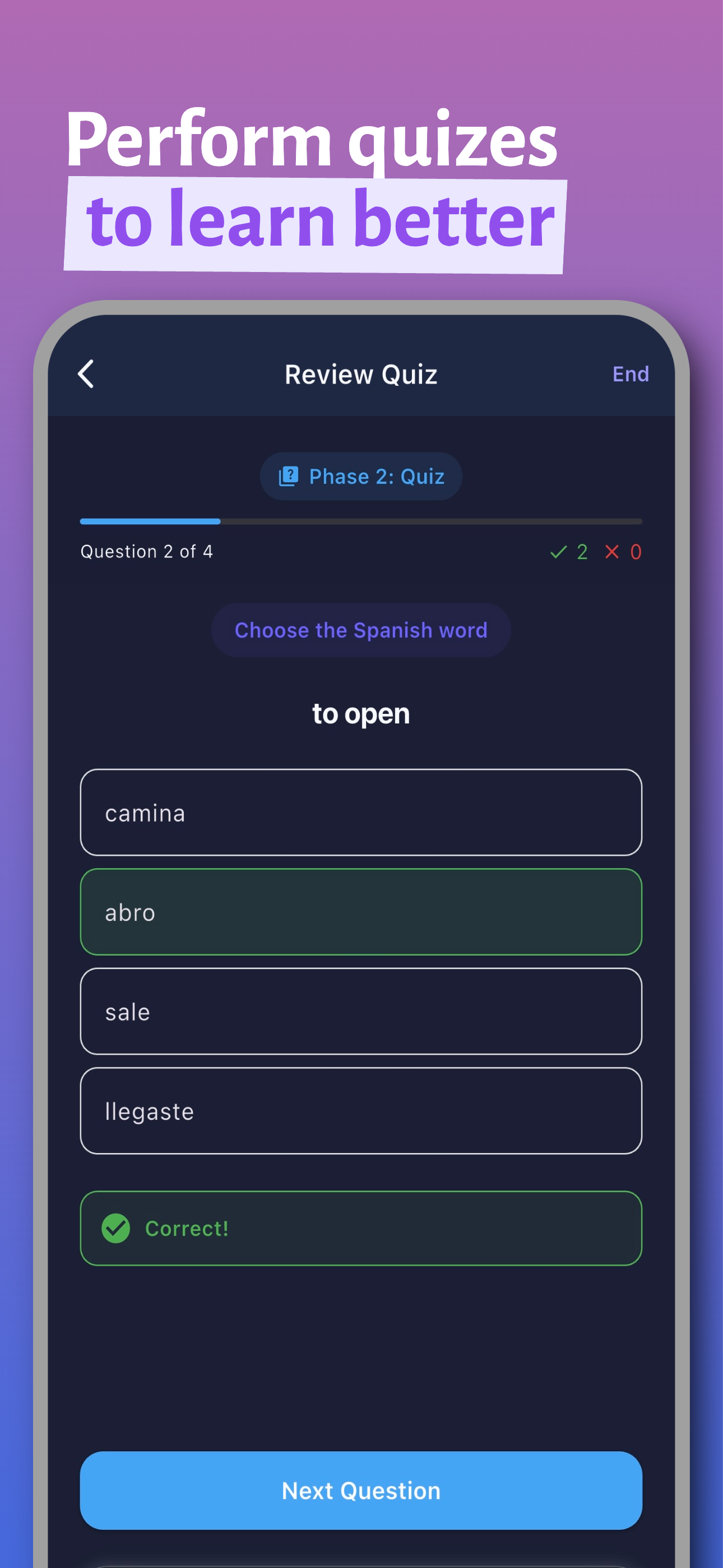
There is a critical difference between studying Spanish and practicing Spanish. Studying is reading grammar explanations, memorizing word lists, and watching tutorial videos. Practicing is actually using the language: speaking, writing, listening to real conversations, and producing sentences from scratch.
Many learners spend 100% of their time in study mode and 0% in practice mode. They build passive recognition but never develop active production ability. The result is someone who can understand written Spanish fairly well but freezes when they need to speak.
The fix: Follow the 70/30 rule. Spend 30% of your time studying (vocabulary, grammar, reading) and 70% practicing (speaking, writing, active recall exercises). If you cannot find a conversation partner, talk to yourself in Spanish. Narrate your daily routine. Describe what you see.
8. Skipping Listening Practice
Reading Spanish and hearing Spanish are two completely different skills. Written Spanish gives you time to decode each word. Spoken Spanish comes at you in a continuous stream where words blend together, syllables get swallowed, and speed varies wildly.
If you only practice reading and writing, you will be shocked the first time a native speaker talks to you at normal speed. The words you know on paper become unrecognizable when spoken naturally.
The fix: Include listening practice from day one. Start with slow, clear audio designed for learners. Gradually increase to podcasts, TV shows, and movies. Even 10 minutes of listening per day trains your ear to parse the sounds of Spanish.
9. Not Learning Phrase Chunks
Individual words are the building blocks of language, but phrase chunks are the prefabricated walls. Native speakers do not construct every sentence from scratch. They rely heavily on memorized phrases, collocations, and formulaic expressions.
Learning “por favor,” “me gustaría,” “lo siento,” and “no te preocupes” as complete units is far more useful than learning each word separately and trying to assemble them on the fly. Chunk learning also helps you internalize grammar patterns without memorizing rules.
The fix: For every new vocabulary word, learn at least one common phrase that contains it. When you learn “tiempo” (time/weather), also learn “hace buen tiempo” (the weather is nice) and “no tengo tiempo” (I do not have time).
10. Setting Unrealistic Timelines
The internet is full of claims like “Become fluent in Spanish in 30 days!” These are marketing fantasies. The Foreign Service Institute estimates that English speakers need 600-750 hours of study to reach professional working proficiency in Spanish. At one hour per day, that is roughly two years.
Unrealistic expectations are dangerous because they lead to disappointment, which leads to quitting. If you expect fluency in three months and do not achieve it, you are likely to conclude that you are bad at languages rather than recognizing that your timeline was wrong.
The fix: Set milestone-based goals instead of deadline-based goals. Aim for A1 level first (about 500 words), then A2, then B1. Celebrate each milestone. The journey to fluency is a marathon, not a sprint.
Follow @vocaswipe on TikTok
Daily Spanish words, common mistake breakdowns, and vocabulary challenges.
11. Relying on Only One Resource
No single app, textbook, course, or teacher can teach you everything. Each resource has strengths and blind spots. A vocabulary app excels at building your word base through spaced repetition, but it will not teach you to hold a conversation. A tutor is great for speaking practice, but expensive for daily vocabulary drilling.
Learners who use a single resource tend to develop lopsided skills. They become strong in whatever that resource emphasizes and weak in everything else.
The fix: Combine two to three complementary resources. Use an SRS app like VocaSwipe for daily vocabulary building. Add a conversation partner or tutor for speaking practice. Include authentic content (podcasts, shows, articles) for listening and reading exposure.
12. Quitting at the Plateau
Every language learner hits a plateau, usually around the upper A2 to B1 level. Progress that was rapid in the beginning slows to a crawl. New words feel harder to learn. Conversations that should be getting easier feel like they have stalled. This is completely normal, and it is exactly where most people quit.
The plateau happens because early progress is driven by high-frequency words and basic patterns that appear everywhere. As you advance, each new word is less frequent and each new grammar point is more nuanced. The returns per hour of study decrease. But this does not mean you have stopped learning. It means the nature of your progress has changed.
The fix: Expect the plateau. When it arrives, change something: switch to a new type of content, start a new vocabulary category, find a conversation partner on a new topic, or set a concrete short-term goal (like learning 100 cooking-related words). The plateau breaks when you introduce novelty while maintaining your daily consistency.
Build the right habits from day one
VocaSwipe handles spaced repetition, active recall, and progress tracking so you can focus on consistent daily practice. Five minutes a day, zero common mistakes.
Key Takeaways
- Vocabulary before grammar. Build a base of 500-1,000 words before diving deep into grammar rules.
- Use spaced repetition. It improves retention by 200% compared to cramming or random review.
- Daily consistency wins. Five minutes every day outperforms two-hour weekend sessions.
- Learn phrases, not just words. Chunk learning builds fluency and natural grammar intuition.
- Combine multiple resources. No single tool covers all skills. Mix apps, conversation, and content.
- Expect and push through plateaus. They are a normal sign of advancing to intermediate level.
Frequently Asked Questions
What is the biggest mistake Spanish learners make?
The biggest mistake is prioritizing grammar over vocabulary in the early stages. Research consistently shows that vocabulary size is the strongest predictor of communicative competence. You can communicate with 2,000 words and broken grammar, but perfect grammar with only 100 words leaves you unable to say much at all. Build your word base first with a tool like focused vocabulary study, then layer grammar on top as you progress.
Should I learn grammar or vocabulary first?
Start with vocabulary. Linguists recommend building a foundation of 500-1,000 high-frequency words before focusing heavily on grammar. At that point, you will already absorb basic grammar patterns naturally through exposure to phrases and sentences. Then dedicate structured study time to grammar rules. This approach is faster because vocabulary gives you immediate comprehension, while grammar alone does not.
Why am I not improving at Spanish?
The most common reasons for plateaus are inconsistent practice, using only one resource or method, and avoiding active production. If you study sporadically, your brain does not get the repeated consolidation cycles needed for long-term retention. If you only use one app or textbook, you miss the multi-angle exposure that cements knowledge. And if you never speak or write in Spanish, you build passive recognition without active recall ability. Fix these three issues and progress usually resumes quickly.